Trusted Xience Stent Supplier for Quality Cardiac Care
A single logistics failure in a cardiology supply chain isn't just a delayed shipment; it's a direct threat to clinical outcomes and facility operational efficiency. Procurement professionals often face the dual pressure of avoiding counterfeit risks in secondary markets while managing complex customs documentation for sensitive medical exports. Identifying a high-capacity Xience stent supplier requires more than a simple inventory check. It demands a partner with proven expertise in global medical logistics and a direct line to authentic Abbott technology, including the XIENCE Skypoint and Sierra systems.
You likely recognize that inconsistent supply chains lead to increased friction and potential stockouts of critical drug-eluting stents. This article provides the framework to optimize your international medical device procurement by identifying the essential markers of a reliable distribution partner. We'll examine the technical criteria for product verification, strategies for reducing logistical friction, and methods for ensuring maximum shelf-life for every unit. This overview clarifies how to secure a long-term supply of premium cardiac hardware through streamlined shipping protocols and rigorous authenticity standards.
Key Takeaways
- Evaluate the technical specifications of the Xience Alpine and Sierra platforms to match specific patient anatomy and lesion complexity.
- Establish rigorous vetting protocols for your Xience stent supplier to ensure product authenticity and secondary market risk mitigation.
- Streamline international procurement by addressing the logistical requirements of temperature-controlled shipping and complex customs documentation.
- Leverage high-capacity distribution networks to maintain consistent inventory levels of authentic Abbott, Medtronic, and Boston Scientific hardware.
The Role of Xience Stents in Modern Interventional Cardiology
The Abbott Xience family represents the global benchmark for drug-eluting stents. It's a cornerstone of interventional cardiology, providing the technical foundation for millions of successful coronary interventions. Procurement teams prioritize this line due to its consistent performance in complex percutaneous coronary interventions (PCI). A reliable Xience stent supplier must provide access to the full portfolio, including Sierra and Alpine models, to meet varying clinical requirements. Market dominance stems from the Everolimus elution mechanism, which has maintained leadership through superior anti-proliferative efficacy and a decade of real-world evidence.
Understanding Drug-Eluting Stent (DES) Technology
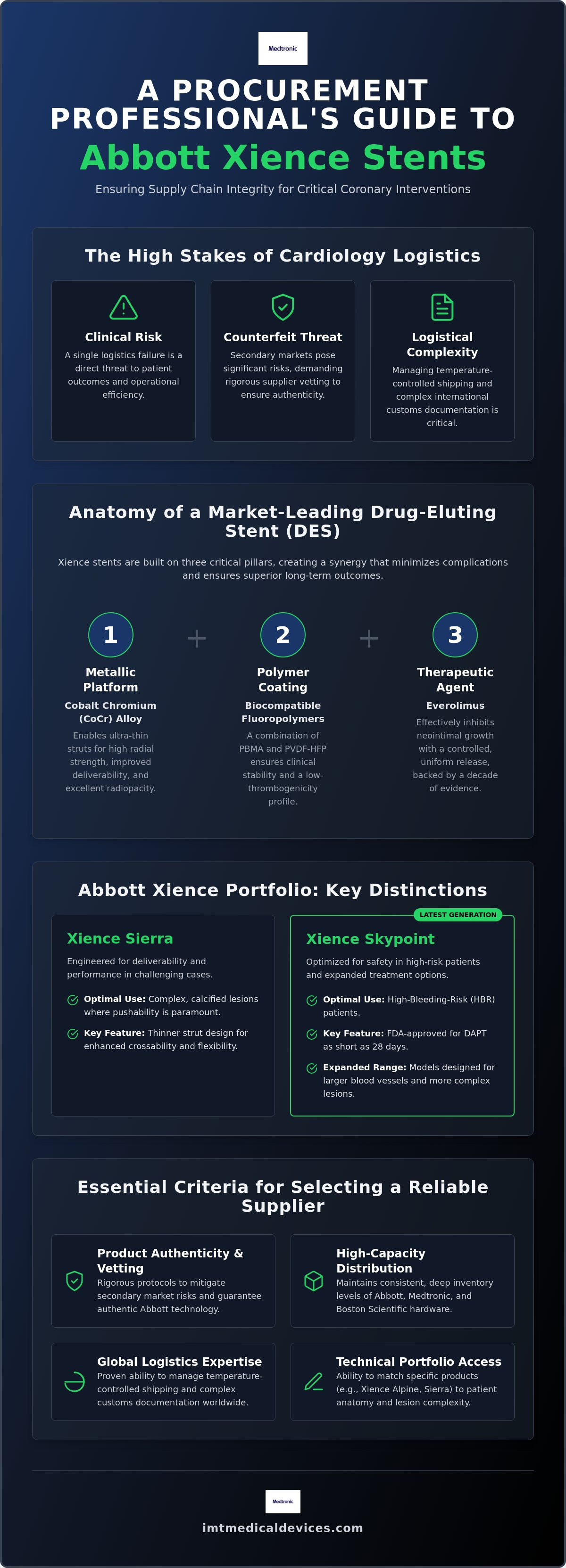
Modern drug-eluting stents rely on three critical pillars: the metallic platform, the polymer coating, and the pharmacological agent. Xience utilizes a Cobalt Chromium (CoCr) alloy for its scaffold. This material selection enables ultra-thin struts, which significantly improves deliverability through tortuous anatomy and enhances vessel apposition. The coating architecture is equally specialized:
- Metallic Platform: Cobalt Chromium alloy for high radial strength and radiopacity.
- Polymer Coating: A combination of PBMA and PVDF-HFP fluorinated polymers for biocompatibility.
- Therapeutic Agent: Everolimus, a macrocyclic lactone that inhibits neointimal growth effectively.
The PVDF-HFP polymer is specifically designed for clinical stability. It facilitates a controlled, uniform release of Everolimus while maintaining a low-thrombogenicity profile. This technical synergy minimizes the risk of late-stage complications often seen in first-generation DES platforms, ensuring the stent remains a market leader for high-volume cardiac centers.
Indications and Clinical Utility
The clinical utility of Xience spans a wide range of coronary interventions, from routine stenoses to highly calcified lesions. Data from over 100 clinical trials confirms a superior safety profile across diverse patient populations. A key development is the recent FDA expansion for high-bleeding-risk (HBR) patients. This approval allows for a one-month dual antiplatelet therapy (DAPT) regimen, providing clinicians with greater flexibility in managing complex patient cohorts who cannot tolerate long-term anticoagulation.
Facilities sourcing coronary stents focus on long-term outcomes, including reduced rates of stent thrombosis and target lesion failure (TLF). The Xience platform consistently demonstrates lower TLF rates compared to competitive DES systems in head-to-head studies. For a high-capacity Xience stent supplier, maintaining a deep inventory of these items is essential for hospital networks managing urgent cardiac care. The combination of thin-strut technology and proven drug elution makes it the preferred hardware for multi-vessel disease and challenging anatomy cases.
Abbott Xience Portfolio: Technical Specifications for Procurement
Procurement strategies for interventional cardiology require a granular understanding of the Abbott Xience product line. Selecting a high-capacity Xience stent supplier ensures access to the specific technical iterations needed for diverse clinical scenarios. While the Xience Alpine remains a standard for high-performance delivery, newer models like Sierra and Skypoint address specific procedural challenges. Alpine is often the baseline for high-volume centers due to its proven tracking and delivery record in standard PCI cases. It's the workhorse of many cardiac labs, providing reliable access to most lesions without requiring specialized hardware.
Xience Sierra vs. Xience Skypoint
The Xience Sierra is engineered for complex lesions and challenging anatomy. It features a thinner strut design and improved crossability, making it the preferred choice for calcified vessels where pushability is paramount. In contrast, the Xience Skypoint represents the latest generation, receiving FDA and CE Mark approval in 2021. Skypoint is optimized for high-bleeding-risk (HBR) patients. As of June 30, 2021, the Skypoint system is FDA-approved for dual antiplatelet therapy (DAPT) as short as 28 days. This specific indication allows clinicians to manage patients with higher bleeding risks more safely. Skypoint also expands the treatment range to larger blood vessels, offering models designed for complex lesion sets that previous generations couldn't reach effectively.
Delivery Systems and Catheter Compatibility
Technical specifications for procurement must include the delivery balloon catheters. These systems are designed for high-pressure expansion and precise placement within the coronary artery. The Multi-Link Vision platform serves as the structural foundation for Xience stents. Compatibility with standard 0.014-inch diagnostic guide wires and 5F or 6F guiding catheters is a baseline requirement. High-capacity suppliers ensure that these delivery systems maintain integrity during transit to avoid lumen collapse or balloon failure during the procedure. This technical synergy minimizes the risk of procedural complications and ensures the device performs according to manufacturer specifications.
Inventory management should account for a broad range of sizing options. Xience stents typically range from 2.25 mm to 4.0 mm in diameter and 8 mm to 48 mm in length. Procurement managers must prioritize shelf-life and batch consistency when ordering in bulk. A reliable Xience stent supplier maintains stock across these specifications to prevent procedural delays in emergency cardiac units. If you're looking to upgrade your facility's inventory, you can view our coronary stent portfolio to compare technical data across manufacturers.
Criteria for Selecting a Xience Stent Supplier
Selecting a high-capacity Xience stent supplier requires a rigorous vetting process focused on logistical competence and product integrity. Procurement teams must move beyond simple price comparisons to evaluate a partner's ability to maintain a stable supply chain for sensitive cardiology implants. A reliable distributor functions as a critical bridge between Abbott's manufacturing sites and international medical facilities. This relationship demands transparency in batch tracking, volume scalability, and regulatory compliance. Authenticity is the primary trust signal in this market, particularly when sourcing in bulk for large hospital networks or regional health systems.
Inventory management for drug-eluting stents hinges on shelf-life guarantees. High-value hardware like the Xience Sierra or Skypoint typically requires a minimum remaining shelf-life of 12 to 18 months upon delivery to ensure operational flexibility. A professional supplier maintains strict first-in, first-out (FIFO) protocols to prevent stock expiration. Furthermore, they must demonstrate expertise in international medical device standards, including ISO 13485 certifications and regional health authority requirements. This technical oversight minimizes the risk of regulatory delays or product rejections at customs.
B2B Procurement Red Flags
Procurement professionals should identify specific markers of unreliable distribution. Opaque pricing models often signal a lack of direct manufacturer relationships or unauthorized secondary market sourcing. Key red flags include:
- Inconsistent Batch Data: Vague information regarding product origin or batch numbers.
- Lead Time Volatility: Poor communication regarding stock availability and fluctuating delivery windows.
- Pricing Fluctuations: Lack of volume-based tiers or sudden cost increases without market justification.
- Documentation Gaps: Inability to provide immediate verification of product authenticity.
Reliable partners provide a predictable, catalog-like experience. They offer clear technical identifiers and manufacturer-specific codes to streamline the ordering process and reduce administrative friction.
Verification and Documentation Requirements
Product traceability is essential for patient safety and clinical accountability. Every shipment from a Xience stent supplier must include a comprehensive documentation package. This typically includes a Certificate of Analysis (CoA) and a Certificate of Origin to verify the manufacturing source. For international exports, the supplier must manage complex customs declarations and ensure compliance with local medical device registries. Verification of wholesaler contract rates is also a standard part of the auditing process. This ensures that the facility receives authentic Abbott Vascular items at competitive, pre-negotiated commercial rates. Maintaining this level of documentation integrity protects the facility from the risks associated with counterfeit products in the global medical supply chain.
Global Logistics and Supply Chain Integrity for DES
International distribution of drug-eluting stents (DES) involves significant logistical complexity. High-value cardiology hardware requires specialized handling to preserve the integrity of the polymer-drug interface. A professional Xience stent supplier manages the entire transit cycle, from manufacturer warehouse to the final clinical destination. This process relies on a robust network of strategic hubs designed to minimize transit times and reduce logistical overhead. Efficiency in these corridors is essential for maintaining consistent stock levels in international hospital networks. Reliable logistics prevent the friction that often disrupts cardiac care delivery in secondary markets.
Strategic positioning in trade corridors like Georgia, Turkey, and the UAE allows for rapid deployment of inventory. These locations serve as vital bridges between major manufacturers and emerging markets. By utilizing these hubs, distributors can bypass standard shipping delays and optimize customs clearance protocols. The goal is to create a seamless flow of hardware that matches the urgent nature of interventional cardiology procedures. Rapid movement through these channels ensures that hospital networks receive authentic technology without the risks associated with prolonged warehouse storage.
Specialized Handling for Drug-Eluting Stents
Environmental stability remains a primary concern for procurement managers. The Everolimus coating on Xience stents is sensitive to temperature fluctuations and humidity. Exposure to extreme conditions can compromise the elution rate or the structural integrity of the PBMA/PVDF-HFP polymer. High-capacity suppliers utilize temperature-controlled packaging and advanced tracking technology to monitor every shipment. International air freight standards for medical devices mandate specific insulation and monitoring protocols for high-value cargo. It's not just about shipping; it's about maintaining a clinical-grade environment until the device reaches the cath lab.
- Monitoring: Real-time data logging for temperature and humidity during transit.
- Packaging: Multi-layered insulation designed for long-haul air transport.
- Security: Tamper-evident seals and specialized tracking for high-value cardiology implants.
Navigating International Export Documentation
The documentation trail for medical exports is exhaustive. A Xience stent supplier must manage regulatory compliance for 50+ countries, each with unique health authority requirements. This includes the preparation of Certificates of Origin, commercial invoices with specific technical codes, and local registration documents. Accuracy in this paper trail prevents costly customs delays and ensures that product shelf-life isn't wasted in transit warehouses. Reliable partners provide complete transparency throughout the export process, ensuring that all regional health standards are met before the shipment arrives. This level of administrative precision is what separates a standard distributor from a specialized medical logistics partner.
Efficient supply chain management is the foundation of quality cardiac care. If your facility requires a partner with proven international export capabilities, you can contact our logistics team to discuss bulk procurement and shipping schedules.
IMT Medical Devices: Leading Global Xience Stent Supplier
IMT Medical Devices operates as a high-capacity bridge in the international cardiology market. Strategic global presence includes regional offices in Georgia, Dubai, Turkey, and Poland. This network facilitates efficient distribution across major trade corridors, ensuring product availability for complex interventional procedures. As an established Xience stent supplier, IMT has successfully exported critical hardware to over 50 countries. Operations focus on logistical excellence, prioritizing the integrity of sensitive implants throughout the entire supply chain. This industrial-scale approach ensures that partners receive authentic, high-performance cardiac technology regardless of geographic location.
Inventory consists of an extensive portfolio of drug-eluting stents from industry-leading manufacturers. Procurement access includes Abbott, Medtronic, and Boston Scientific technology. This breadth of choice allows hospital networks to standardize hardware while maintaining a reliable supply line. Centralizing distribution through strategic hubs reduces transit times and mitigates the risks associated with international medical device shipping. Reliable inventory management prevents stockouts of critical cardiology hardware in high-volume cardiac centers.
Why Partner with IMT for Cardiology Sourcing?
The business model is strictly B2B, designed for procurement professionals who require volume-based pricing and reliable supply chain solutions. IMT offers a comprehensive range of hardware for interventional cardiology. Partners gain access to premium Drug-Eluting Stents along with essential procedural components. Inventory includes PTCA Balloons and Guiding Catheters, allowing for consolidated ordering and reduced administrative friction. Selecting a high-capacity Xience stent supplier ensures that your facility has access to the full Abbott portfolio, including the Sierra and Skypoint generations.
- Direct B2B Focus: Transactional efficiency for large-scale hospital networks.
- Volume Pricing: Tiered commercial structures for bulk procurement.
- Inventory Depth: Consistent stock of Abbott, Medtronic, and Boston Scientific products.
- Logistical Precision: Specialized handling for temperature-sensitive cardiology hardware.
Streamlined Procurement Process
The export lifecycle at IMT is optimized for speed and accuracy. From initial inquiry to final delivery, the team manages every stage of the international trade process. Specialized documentation support ensures that all Certificates of Origin and health authority filings are correct. This precision minimizes customs delays in complex regulatory environments. The team handles technical identifiers and manufacturer codes to ensure data accuracy throughout the transaction. If your facility requires current inventory data, please Contact IMT Medical Devices for Xience Stent Price Lists and Availability. Reliable logistical stability is the foundation of an optimized cardiac care supply chain.
Optimizing Your Cardiology Supply Chain
Efficient cardiology procurement hinges on technical precision and logistical reliability. Selecting a high-capacity Xience stent supplier ensures your facility maintains access to the full Abbott portfolio while mitigating the risks of counterfeit products and supply chain disruptions. By prioritizing partners with verified traceability and temperature-controlled distribution networks, hospital administrators can focus on clinical outcomes rather than inventory gaps. Strategic distribution hubs and comprehensive export documentation remain the essential pillars for successful international medical device sourcing.
IMT Medical Devices operates as a specialized wholesaler for Abbott, Medtronic, and Terumo products. With a strategic presence in Georgia, the UAE, Turkey, and Poland, the entity currently exports authentic cardiology hardware to over 50 countries. This global reach provides the infrastructure necessary to handle sensitive drug-eluting stents and complex interventional catheters with industrial-scale efficiency. You can Request a Wholesale Quote for Xience Stents and Cardiology Supplies to stabilize your facility's inventory levels. Secure a reliable long-term partner to streamline your international medical supply chain today.
Frequently Asked Questions
Who is the primary manufacturer of Xience stents?
Abbott is the primary manufacturer of the Xience stent family. These drug-eluting stents are produced under the Abbott Vascular division and represent a core component of their interventional cardiology portfolio. The manufacturer maintains rigorous quality control standards to ensure the consistency of the Everolimus drug elution and the structural integrity of the Cobalt Chromium scaffold across all technical iterations.
What are the different models available in the Xience stent family?
The Xience family includes several versions designed for specific clinical needs and vessel sizes. Current models include Xience V, Xience Nano, Xience PRIME, Xience Xpedition, and Xience Alpine. The portfolio also features the newer Xience Sierra for complex lesions and the Xience Skypoint system, which is optimized for larger vessels and high-bleeding-risk patient protocols.
How do I verify the authenticity of a Xience stent from a wholesaler?
Verification requires cross-referencing batch numbers and requesting a Certificate of Analysis (CoA) and Certificate of Origin (CoO). A reliable Xience stent supplier provides full traceability back to Abbott’s manufacturing facilities. Procurement teams should also verify the tamper-evident seals on the primary packaging and ensure all technical codes match the official manufacturer catalog to mitigate secondary market risks.
What is the typical shelf-life of a Xience drug-eluting stent?
Typical shelf-life for these drug-eluting stents ranges from 12 to 18 months upon delivery to the facility. This window ensures that cardiac labs have sufficient operational flexibility for inventory rotation. Procurement managers should specify minimum expiration requirements during the inquiry phase. Professional distributors utilize first-in, first-out (FIFO) inventory protocols to maximize the usable life of every unit shipped.
Can Xience stents be shipped internationally with temperature monitoring?
International shipments utilize temperature-controlled packaging and real-time data loggers to ensure environmental stability. This monitoring is critical for maintaining the integrity of the Everolimus drug coating and the polymer matrix during long-haul air freight. A specialized Xience stent supplier manages these logistics to prevent exposure to extreme conditions that could compromise the device’s clinical performance or regulatory compliance.
What documentation is required for importing Xience stents into the UAE or Turkey?
Importing into the UAE or Turkey requires a commercial invoice, detailed packing list, Certificate of Origin, and Certificate of Analysis. Compliance with local health authority registries and specialized customs declarations for medical devices is also mandatory. Distributors with strategic offices in these regions provide the necessary administrative support to navigate these complex regulatory frameworks and prevent transit delays.
Does IMT Medical Devices offer bulk pricing for Abbott Xience products?
IMT Medical Devices provides volume-based pricing structures for bulk procurement of Abbott Xience products. This B2B focus supports large hospital networks and regional distributors requiring consistent inventory of authentic interventional hardware. Transactional efficiency is prioritized through clear technical identifiers and manufacturer-specific codes, allowing for rapid order processing and consolidated shipping of high-value cardiology supplies.
How does the Xience Sierra differ from the previous Xience Alpine model?
Xience Sierra features an enhanced design for complex lesions and challenging anatomy compared to the Alpine model. Technical improvements include thinner struts and increased pushability, which facilitate easier navigation through calcified or tortuous vessels. While Alpine remains a reliable workhorse for standard procedures, Sierra provides the technical specifications needed for more difficult percutaneous coronary interventions and improved vessel apposition.