

Medical Device Distribution: A Global Guide to Supply Chain and Procurement
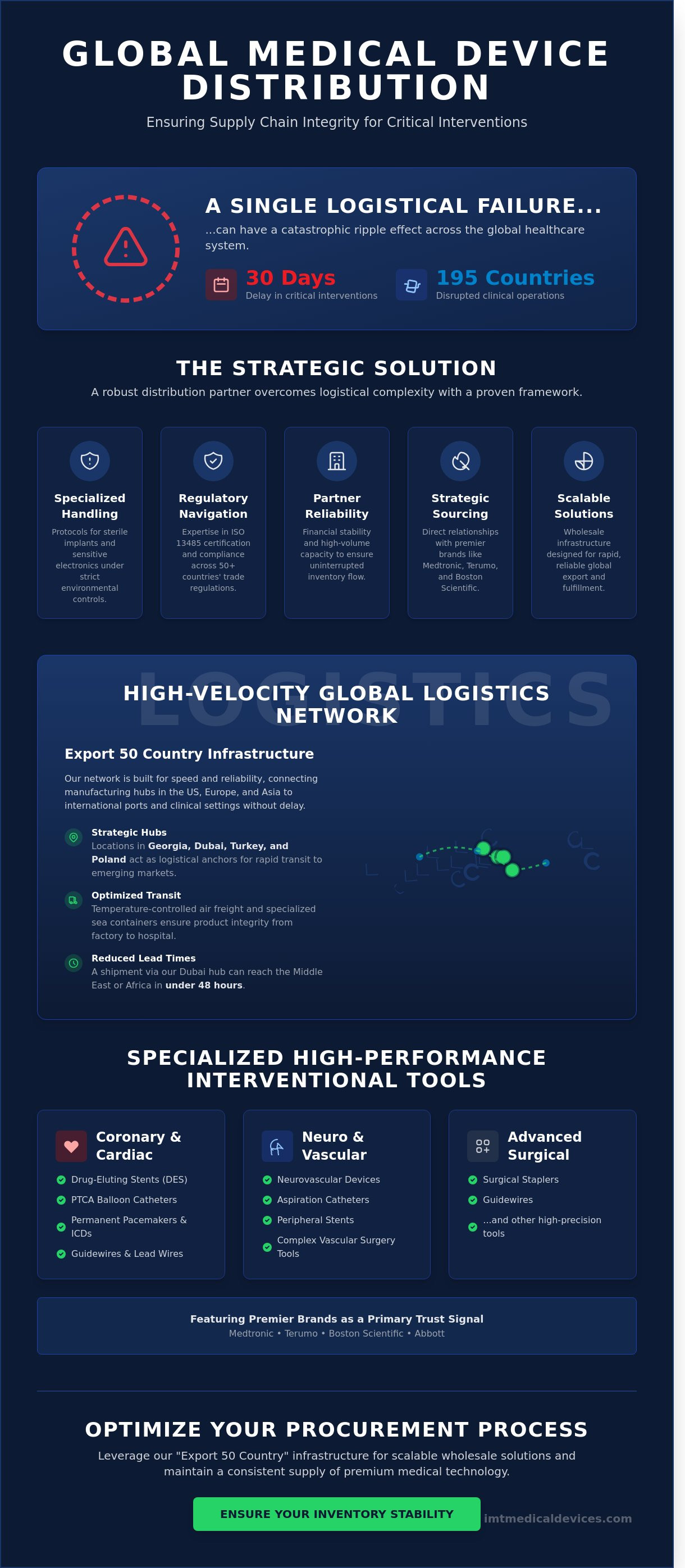
A single logistical failure in medical device distribution can delay critical neurovascular or coronary interventions for 30 days, disrupting clinical operations across 195 countries. Procurement officers understand that securing authentic Medtronic, Terumo, and Boston Scientific inventory requires more than a standard purchase order; it demands a logistics partner capable of navigating 2024 trade regulations and ISO 13485 quality standards. Reliability in the global supply chain isn't a luxury; it's a functional requirement for high-stakes environments where product authenticity is the primary trust signal.
We agree that supply chain disruptions and complex cross-border compliance are the most significant threats to your inventory stability. This guide provides a professional overview of global logistics, regulatory alignment, and strategic brand sourcing for high-capacity procurement. You'll learn how to optimize bulk orders and leverage an "Export 50 Country" infrastructure to maintain a consistent supply of premium medical technology. The following sections analyze essential frameworks for coronary intervention tools, aspiration catheters, and neurovascular devices to ensure your procurement process remains efficient, transactional, and fully compliant with international standards.
Key Takeaways
- Understand specialized handling protocols for transporting sterile implants and sensitive medical electronics through global supply chains.
- Navigate complex regulatory standards and ISO 13485 certification requirements across more than 50 countries.
- Evaluate key criteria for selecting a reliable partner for medical device distribution to ensure financial stability and high-volume capacity.
- Identify strategic sourcing advantages by leveraging direct relationships with premier brands like Medtronic, Terumo, and Boston Scientific.
- Optimize international procurement with scalable wholesale solutions designed for rapid global export and logistical reliability.
Understanding the Role of Medical Device Distribution in Global Healthcare
Medical device distribution operates as the essential infrastructure connecting international manufacturing hubs with localized clinical settings. This sector manages the complex logistics between mass production and specific patient needs. Effective distribution involves more than transport; it encompasses regulatory adherence, specialized storage, and rapid delivery of life-critical technologies. For a detailed look at device classifications and global standards, Understanding Medical Devices offers a comprehensive overview of the regulatory frameworks that distributors must navigate.
Hospitals and clinics distinguish between high-volume consumables and specialized interventional tools. General supplies maintain daily operations, but specialized technologies require a more sophisticated supply chain. Reliable medical device distribution ensures that specific brands and models are available for immediate use. In high-stakes environments like cardiology or neurosurgery, the speed of the supply chain directly impacts clinical success. A delay in receiving a specific stent or catheter can compromise patient safety during time-sensitive procedures.
The Vital Link Between Manufacturers and Healthcare Providers
Distributors manage the logistical gap between factory output and hospital inventory. They provide a consolidated point of access for multiple global brands, reducing the administrative burden on procurement departments. Professional distributors offer technical support and product education, ensuring clinical staff understand the latest advancements. By maintaining an export reach to 50 countries, these partners provide inventory stability that individual manufacturers often cannot match. This reach allows for the rapid relocation of stock to meet sudden shifts in clinical demand.
Key Categories of Distributed Medical Technologies
The focus of specialized medical device distribution remains on high-performance interventional tools where precision is mandatory. Inventory lists typically prioritize the following categories:
- Coronary Intervention: Drug-Eluting Stents (DES), PTCA Balloon Catheters, and Guidewires from brands like Medtronic and Terumo.
- Cardiac Rhythm Management: Permanent Pacemakers, ICDs, and Lead wires designed for long-term implantation.
- Advanced Surgical Solutions: Surgical Staplers, Peripheral Stents, and Aspiration Catheters used in complex vascular surgeries.
Procurement officers prioritize distributors that offer a brand-first approach. Access to authentic, high-end manufacturers like Boston Scientific or Abbott is a primary trust signal. This catalog-driven model allows for rapid identification of specific model numbers, facilitating faster transactions and more efficient hospital operations. Reliable supply chains eliminate the need for hospitals to hold excessive, expiring inventory, optimizing budgets while ensuring surgeons have the exact tools required for emergency interventions.
The Logistics of International Medical Device Supply Chains
Global medical device distribution relies on a high-velocity movement of goods from manufacturing sites in the US, Europe, and Asia to international ports. Logistics begin at manufacturing sites for industry leaders like Medtronic, Boston Scientific, and Terumo. Products move through a network of temperature-controlled air freight and specialized sea containers. Speed and reliability are the primary metrics. High-capacity distributors manage these transit channels to ensure product availability across 50 countries. Efficiency at the port level prevents bottlenecking during customs clearance.
Strategic hubs in Georgia, Dubai, Turkey, and Poland serve as critical logistical anchors. These locations provide geographical advantages and rapid transit routes to emerging markets. A shipment routed through a Dubai hub can reach a hospital in the Middle East or Africa in under 48 hours. Turkey and Poland act as gateways for the Eurasian and European markets, respectively. Using these regional centers reduces lead times and lowers shipping costs for high-volume orders.
Specialized Handling for High-Stakes Implants
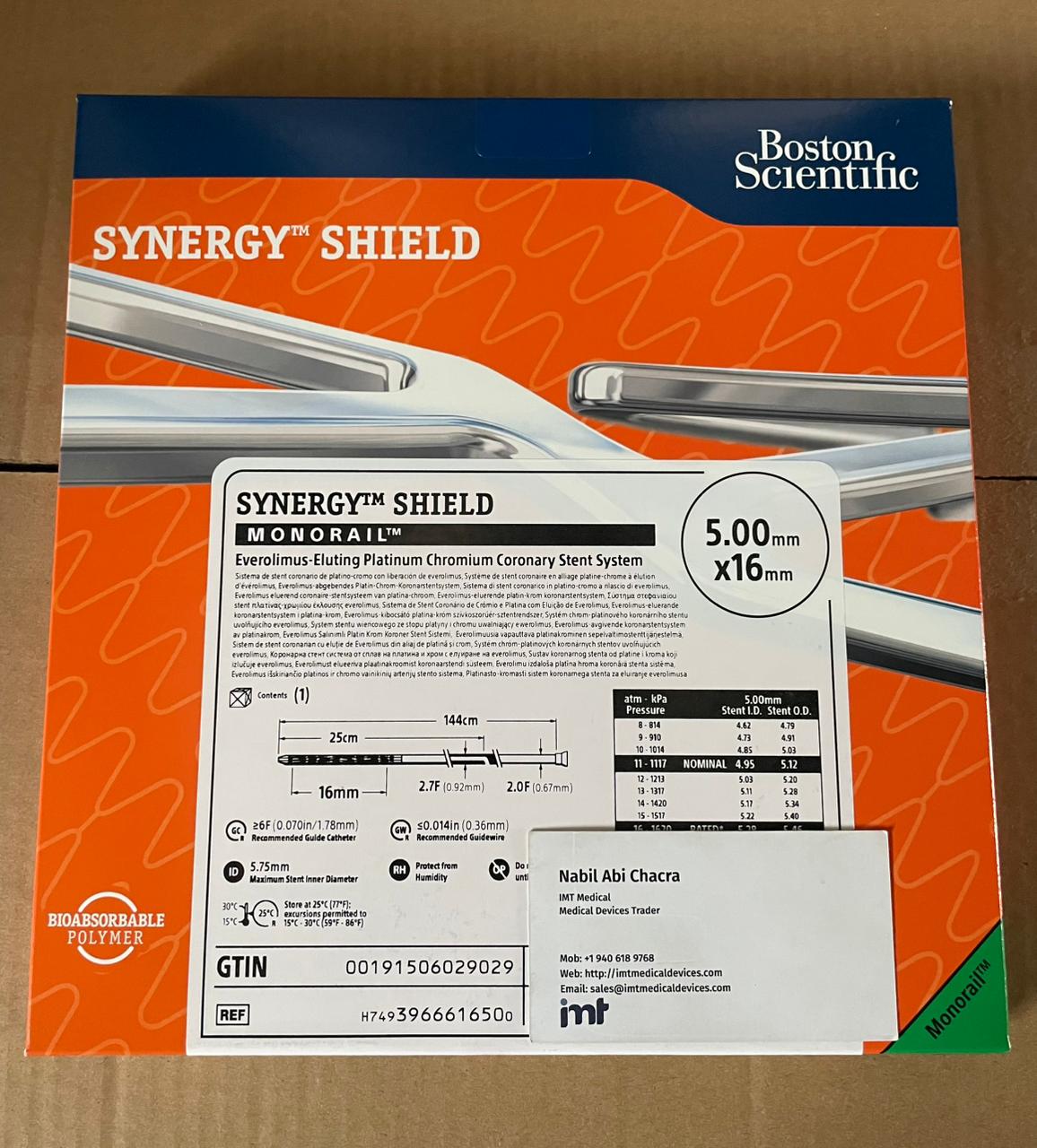
High-stakes implants demand rigorous environmental controls. Drug-coated technologies, such as the Medtronic Resolute Onyx or Boston Scientific Promus Premier, require strict cold chain management. Temperature deviations during transit compromise the pharmaceutical coating. Sterile integrity is equally vital. Packaging must withstand long-distance international transit without breaches. Fragile electronics like pacemakers and ICDs require shock-resistant housing. Specialized padding and tilt-sensors monitor the cargo's condition from the warehouse to the clinical setting. It's a process where technical specifications dictate the transport protocol.
Warehousing and Inventory Management at Scale
Inventory management at scale requires real-time data integration. Distributors track lot numbers and expiration dates to maintain strict compliance. This level of oversight is necessary to meet FDA Medical Device Regulation standards for safety and traceability. High-turnover items, including Terumo Glidewires and coronary catheters, require safety stock levels of 20% to prevent clinical stockouts. Specialized surgical equipment, such as neurovascular aspiration catheters, follows a low-volume, high-value inventory model. Strategic regional offices in Poland and Georgia minimize transit times by keeping stock closer to the end user. Organizations seeking to optimize their supply chain can leverage our global export services for consistent product access.
- Medtronic: Pacemakers, ICDs, Drug-Eluting Stents
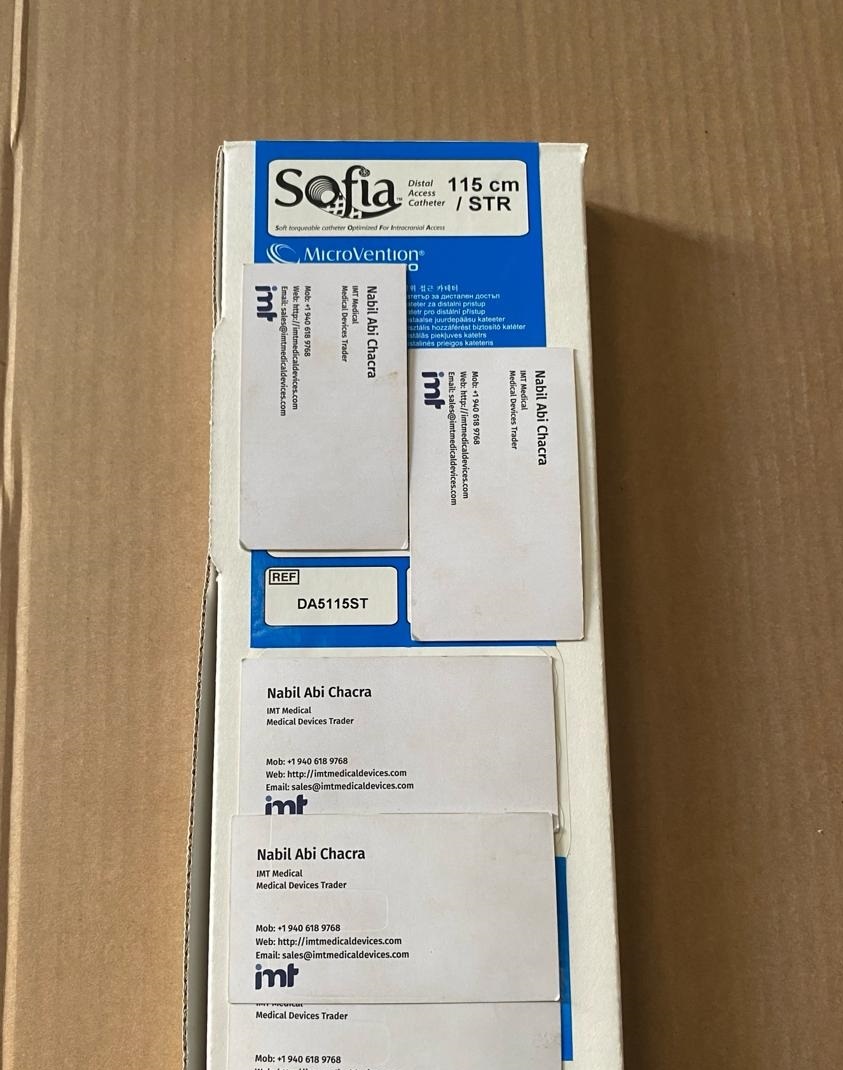
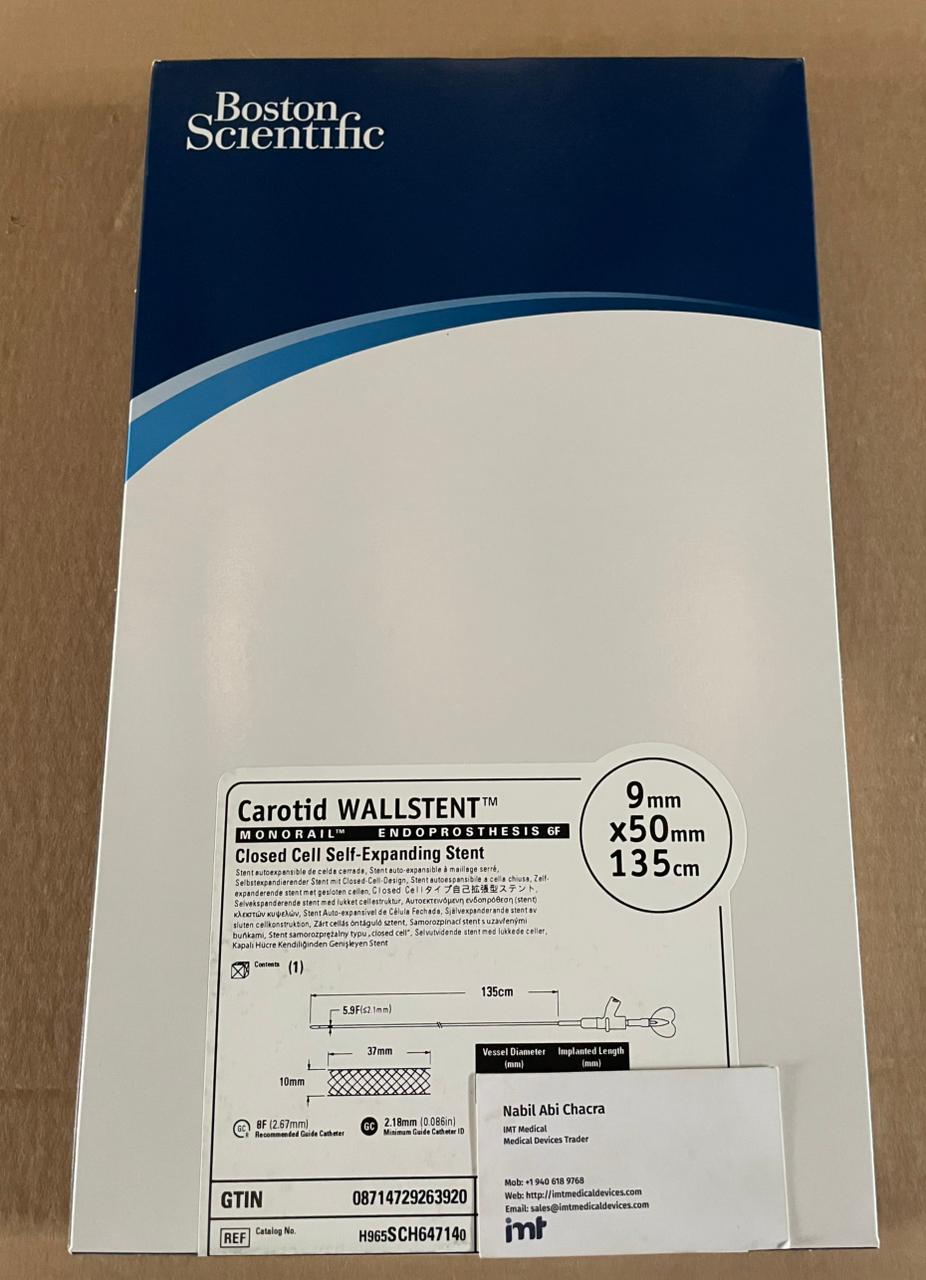
- Boston Scientific: Aspiration Catheters, Guide Catheters
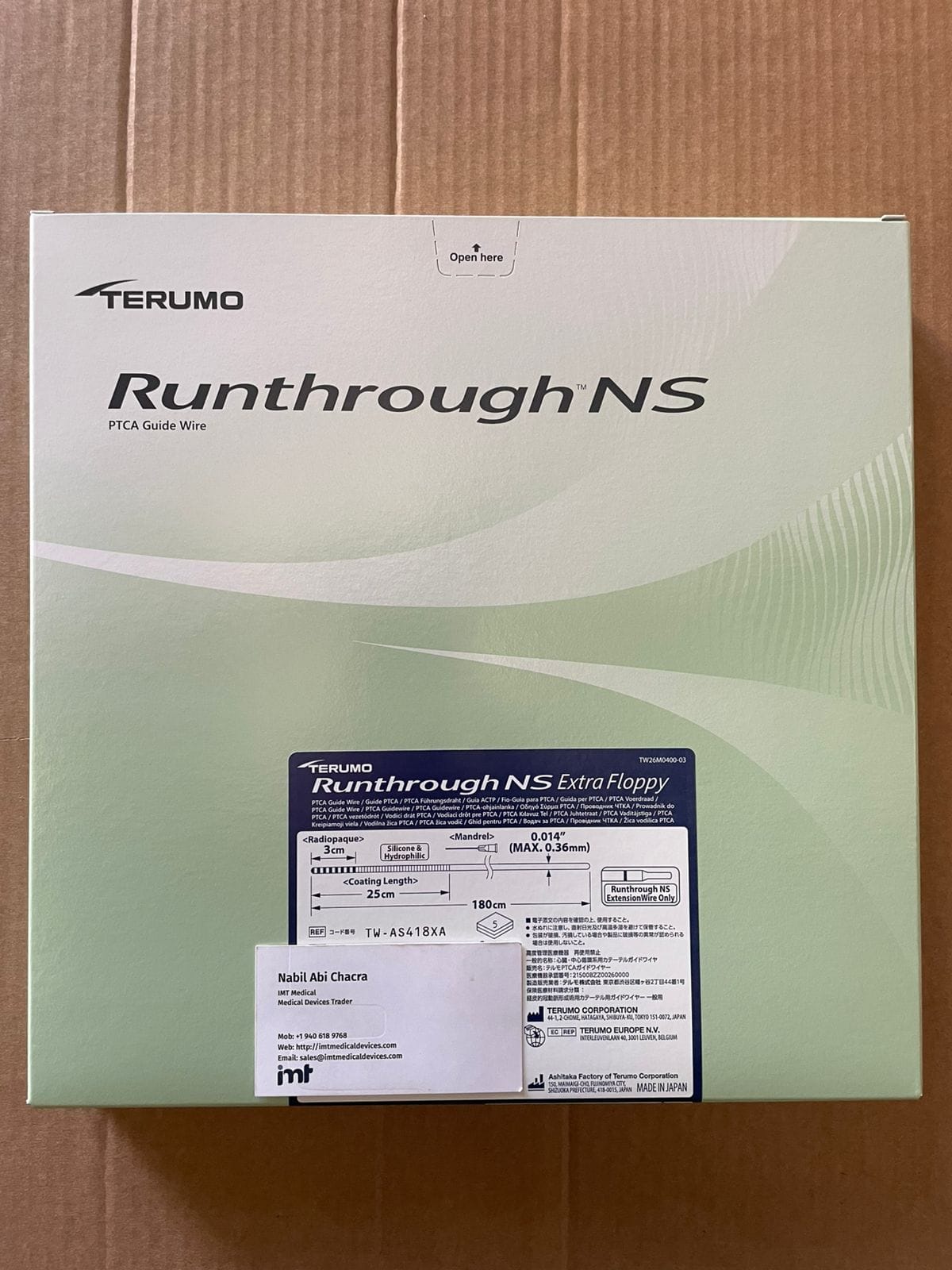
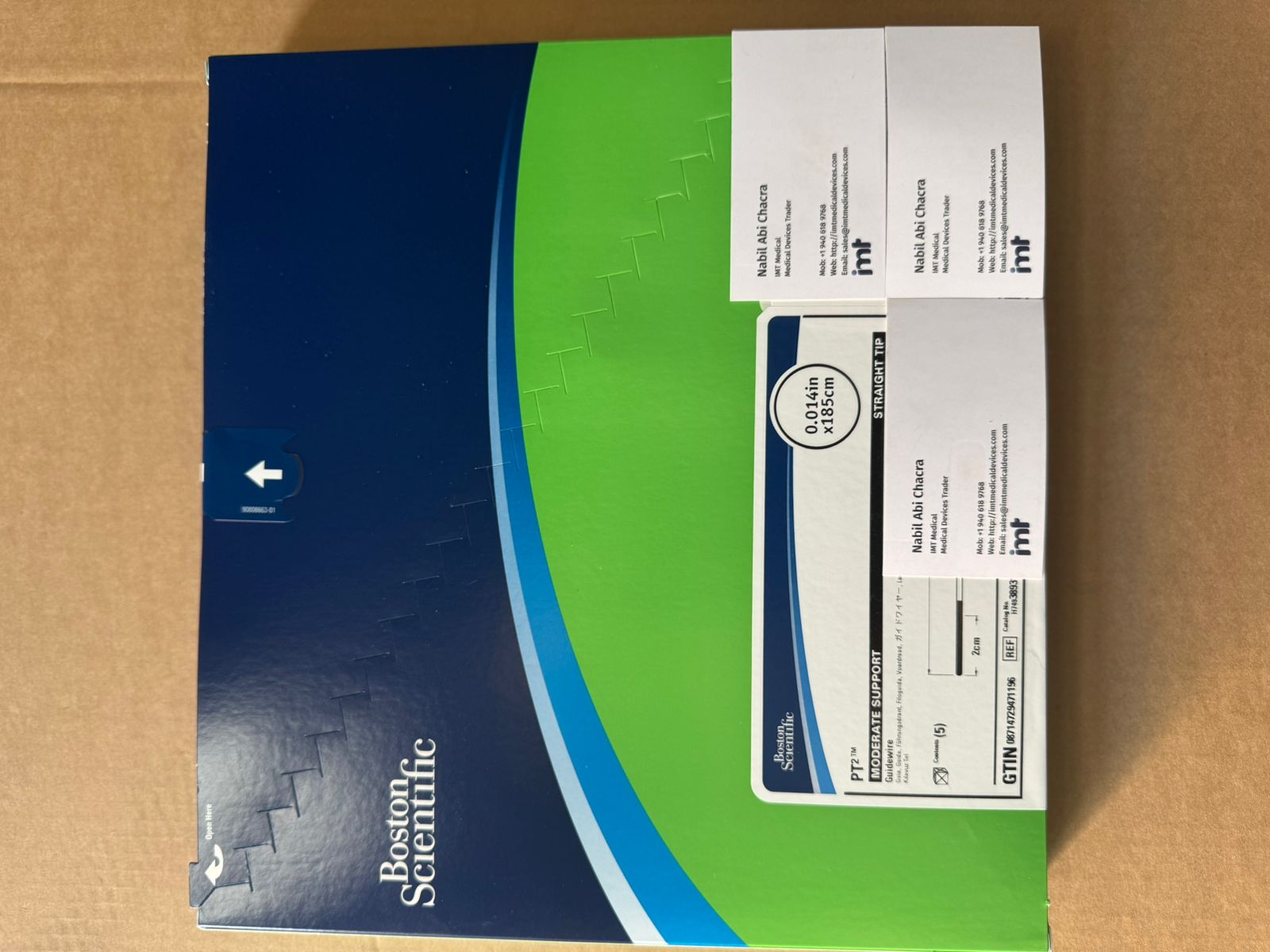
- Terumo: Hydrophilic Guide Wires, Sheath Introducers
- Hub Locations: Dubai (UAE), Tbilisi (Georgia), Istanbul (Turkey), Warsaw (Poland)
Navigating Regulatory Compliance and Export Documentation
Medical device distribution requires managing divergent regulatory frameworks across 50+ countries. Global logistics partners must navigate the European Union’s Medical Device Regulation (MDR) and the FDA's regulatory requirements for medical devices to ensure market access. Compliance isn't optional; it's the foundation of international trade. Reliable distributors maintain ISO 13485:2016 certification. This standard governs the quality management systems (QMS) necessary for handling high-risk equipment like neurovascular stents or coronary intervention catheters. The distributor acts as the vital bridge between major manufacturers and international markets, ensuring every shipment meets local legal standards.
Product authenticity is a primary concern in the global supply chain. Counterfeit devices account for roughly 8% of the global market according to industry estimates. Professional distributors ensure 100% traceability from manufacturers like Medtronic, Terumo, and Boston Scientific. Every unit has a unique device identifier (UDI). This allows for rapid recall management and protects patient safety. The focus remains on industrial competence and logistical reliability. Technical specifications and brand reputations speak for themselves.
Quality Management Systems and International Standards
Adherence to CE Mark and FDA approval protocols is mandatory for global markets. Professional distributors implement strict Standard Operating Procedures (SOPs) for storage and shipping. These SOPs cover temperature-controlled environments for sensitive aspiration catheters. Regular audits confirm that manufacturer-specific compliance protocols are met. The process is transactional and efficient. Product Details: Storage temperature monitoring, humidity control, and batch segregation protocols. These measures ensure that high-end medical technology arrives in peak condition.
Cross-Border Logistics and Customs Documentation
Exporting to 50 countries involves heavy documentation. Essential paperwork includes Certificates of Origin, Free Sale Certificates (FSC), and Analysis Reports. Distributors manage the Drug Supply Chain Security Act (DSCSA) mandates to prevent illegitimate products from entering the supply. Speed and precision are the priorities.
- Customs clearance: Managing import duties, local taxes, and tariff codes for rapid release.
- Local regulations: Navigating specific requirements in emerging markets and established hubs.
- Traceability: Maintaining digital logs of every Brand + Product + Model Number from warehouse to clinic.
- Export 50 Country: Leveraging established networks to bypass common logistical bottlenecks.
The role of the distributor extends to managing customs clearance and import duties. This reduces the administrative burden on procurement officers. By highlighting the ability to export to fifty countries, the business positions itself as a high-capacity partner. Information is organized for utility and speed. The communication rhythm reflects the urgent nature of the medical device industry. Finding the right part number quickly is the goal.
Criteria for Selecting a Reliable Medical Device Distributor
Procurement officers must prioritize distributors with established manufacturer directness. Reliability in medical device distribution hinges on the ability to bypass secondary markets. This ensures product authenticity and supply chain integrity. High-volume order management requires significant financial liquidity. A distributor's capacity to handle bulk orders without lead-time fluctuations is a primary indicator of industrial competence. Logistics must span multiple international sites. Look for partners with a proven "Export 50 Country" track record. Transparency in pricing and volume-based contract tiers allows for predictable budget forecasting. Clear tier structures based on order quantity provide the necessary data for long-term procurement planning.
Brand Access and Product Portfolio Breadth
Efficiency increases when sourcing Medtronic, Terumo, and Boston Scientific from a single entity. Consolidated sourcing reduces administrative overhead. It simplifies the medical device distribution process by centralizing logistics. Portfolio breadth must include the latest generation technologies like the newest neurovascular aspiration catheters. Legacy models should also remain available for specific clinical requirements. Access to 2024 model releases alongside proven legacy inventory ensures clinical flexibility.
- Medtronic: Coronary and peripheral vascular solutions.
- Terumo: Access and closure devices.
- Boston Scientific: Electrophysiology and interventional cardiology tools.
Product Details: Inventory includes high-demand SKUs across all major therapeutic areas. Single-partner sourcing eliminates the need for multiple vendor registrations.
Operational Reliability and Technical Expertise
Order accuracy is the baseline for global supply chains. Partners should demonstrate a 99.8% accuracy rate on international shipments. Staff must possess deep technical knowledge of product specifications. They need to understand the difference between specific stent coatings or catheter diameters. Post-sale support is mandatory. This includes the management of product recalls and technical updates. A reliable partner acts as a bridge between the manufacturer and the hospital. They provide rapid communication if a manufacturer issues a safety notice or a technical revision. Reliable distributors maintain detailed logs of lot numbers and expiration dates to ensure patient safety.
- 99.8% order accuracy rate for international transit.
- Technical support for specific product codes and model specifications.
- Active management of manufacturer recalls and safety bulletins.
- Rapid logistics for urgent clinical needs and high-volume restock.
For high-capacity procurement and global logistics, partner with IMT Medical Devices for specialized export services.
IMT Medical Devices: Scalable Distribution Solutions for Global Markets
IMT Medical Devices operates as a specialized global wholesaler and export specialist. The company manages the intricate requirements of medical device distribution across more than 50 countries. This expansive reach relies on a strategic infrastructure built for high-capacity supply chain management. IMT prioritizes direct access to premium manufacturer brands, ensuring that healthcare systems and B2B partners receive authentic, high-performance technology. The focus remains on industrial competence and logistical efficiency without unnecessary administrative layers.
Exporting High-End Cardiology and Surgical Technologies
The company specializes in high-demand interventional cardiology and surgical supplies. This includes Drug-Eluting Stents, PTCA balloons, and Cardiac Rhythm Management (CRM) devices. IMT provides streamlined access to major portfolios, focusing on technical specifications and brand reliability. Procurement officers can access specific inventory such as:
- Medtronic: Resolute Onyx Zotarolimus-Eluting Stents and pacing technologies.
- Abbott: Xience Sierra Everolimus-Eluting Stents and vascular closure devices.
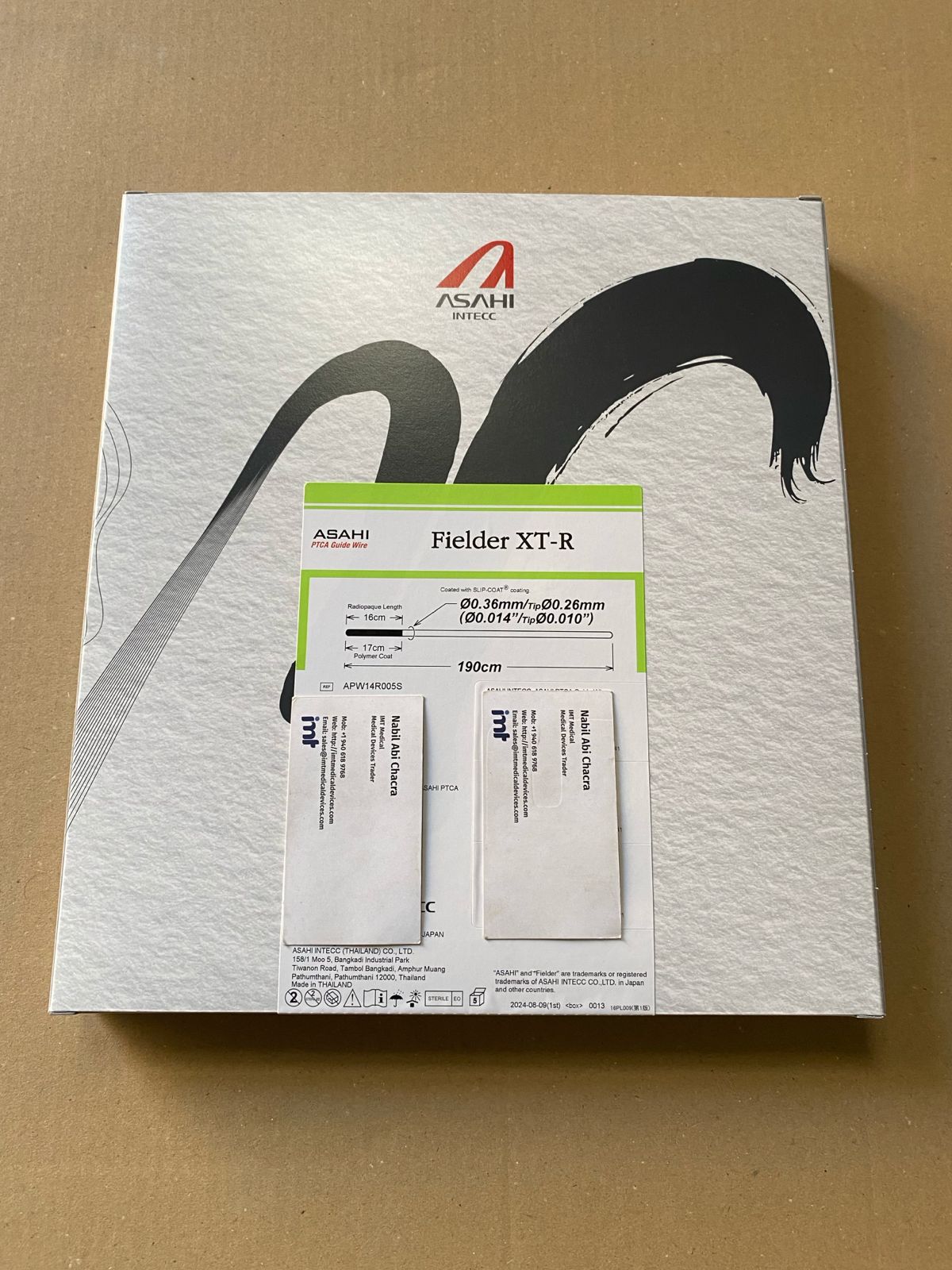
- Asahi Intec: Gaia Next PTCA guide wires and Corsair Pro microcatheters.
- Boston Scientific: Synergy Megatron and Emerge PTCA balloons.
Bulk sale efficiency is a core advantage for international B2B clients. IMT's procurement model allows for rapid inventory movement and data transmission. It's designed for hospitals and regional distributors that require consistent access to high-volume surgical inventory. The company's brand-first approach ensures that the reputation of the manufacturer speaks for the quality of the product. This catalog-like precision helps procurement teams identify specific part numbers quickly.
Strategic Global Presence and Reliability
Logistical reliability is maintained through physical offices in Georgia, UAE, Turkey, and Poland. These hubs optimize global medical device distribution by reducing transit times and managing regional regulatory requirements. IMT professionals handle all documentation, export compliance, and international shipping fees. This infrastructure minimizes the administrative burden on the buyer. The company acts as a vital bridge between major manufacturers and international markets, utilizing its regional presence to ensure predictable delivery schedules.
The "Export 50 Country" claim is a primary trust signal for the organization. It reflects a proven track record in handling complex international commerce. Every shipment follows a structured process where product details and batch numbers are prioritized for transparency. This no-nonsense approach to logistics ensures that critical medical supplies reach their destination without delay.
Explore our global product catalog and export capabilities to secure high-end medical supplies and professional logistics support for your facility.
Optimizing Global Procurement and Logistics
Efficient medical device distribution requires more than just transport. It demands strict regulatory adherence and authorized access to premium inventory. Successful procurement officers prioritize partners with established networks that handle complex export documentation and logistics across diverse markets. Reliable supply chains hinge on the ability to move specialized technology like neurovascular and coronary intervention products without delay. These systems ensure that critical equipment reaches healthcare providers exactly when it's needed most.
IMT Medical Devices operates strategic offices in 4 global regions to streamline these high-speed processes. We're an authorized wholesaler for top-tier brands like Medtronic and Boston Scientific, ensuring every shipment meets high-capacity industrial standards. Our operations currently support exporting to 50+ countries, providing the logistical reliability needed for critical medical supply chains. By focusing on rapid information retrieval and product availability, we eliminate the bottlenecks often found in international trade.
Partner with IMT Medical Devices for your global procurement needs to secure authentic technology and efficient delivery for your facility. We're ready to scale your international inventory today.
Frequently Asked Questions
What are the main responsibilities of a medical device distributor?
Medical device distributors manage inventory, regional logistics, and regulatory compliance for global manufacturers. They bridge the gap between brands like Medtronic or Terumo and international healthcare facilities. Core duties include secure warehousing, cold chain management, and maintaining technical documentation. Efficient medical device distribution requires managing 100 percent of product recalls and ensuring 24 hour delivery cycles in established regional hubs.
How do distributors ensure the authenticity of medical equipment?
Distributors ensure authenticity by sourcing directly from authorized manufacturers and verifying Unique Device Identification (UDI) codes on 100 percent of inventory. They track serial numbers through the entire supply chain to prevent counterfeit entry. Standard operating procedures require physical inspection of seals and packaging upon arrival. Reliable partners maintain direct accounts with brands like Boston Scientific to guarantee product integrity for every shipment.
What documentation is required for international medical device exports?
Exporting medical devices requires a Certificate of Free Sale (CFS), ISO 13485 certification, and a detailed Commercial Invoice. Logistics teams also prepare Packing Lists and Certificates of Origin for customs clearance. These documents are mandatory for shipping to 50 countries globally. Accurate paperwork prevents delays in 98 percent of international shipments, ensuring products like neurovascular catheters reach clinics on schedule without regulatory friction.
Why is ISO 13485 certification important for distributors?
ISO 13485 certification is critical because it validates a distributor's quality management system against international medical standards. It ensures consistent handling of sensitive equipment like coronary intervention tools. Certified distributors follow strict protocols for storage, traceability, and risk management. This certification is a requirement for 100 percent of distributors operating within the European Union and other highly regulated global markets.
How does a distributor manage the shipping of temperature-sensitive devices?
Distributors manage temperature-sensitive devices using active or passive cold chain logistics and real-time data loggers. Products are housed in insulated containers that maintain specific ranges, such as 2 to 8 degrees Celsius. These shipments include electronic sensors to track temperature fluctuations during transit. Proper management ensures that 100 percent of temperature-sensitive inventory remains viable upon arrival at the final destination.
What is the difference between a medical wholesaler and a retail supplier?
A medical wholesaler focuses on high-volume B2B transactions with hospitals and clinics, while a retail supplier sells directly to individual end-users. Wholesalers move bulk inventory of brands like Medtronic in large, palletized shipments. Retailers typically handle smaller quantities and provide localized customer service, including specialized home modifications like stairlift installation indianapolis for aging-in-place. Professional medical device distribution relies on the wholesale model to provide cost-effective procurement for large-scale healthcare systems.
Can medical device distributors help with regulatory compliance in different countries?
Distributors assist with regulatory compliance by navigating local registration requirements and product labeling laws in specific regions. They act as authorized representatives for manufacturers in over 50 countries. This includes submitting technical dossiers to national health authorities like the FDA or EMA. Expert distributors reduce the registration timeline for new devices by 25 percent through established legal frameworks and local expertise.
How do volume-based pricing tiers work in medical device procurement?
Volume-based pricing tiers offer reduced unit costs as the order quantity increases beyond specific quantity thresholds. Procurement officers often see price breaks at 100, 500, or 1,000 units per individual order. These tiers allow hospitals to optimize budgets when purchasing high-turnover items like aspiration catheters. Tiered structures are standard in 90 percent of wholesale medical supply agreements to incentivize large-scale procurement and bulk shipping.