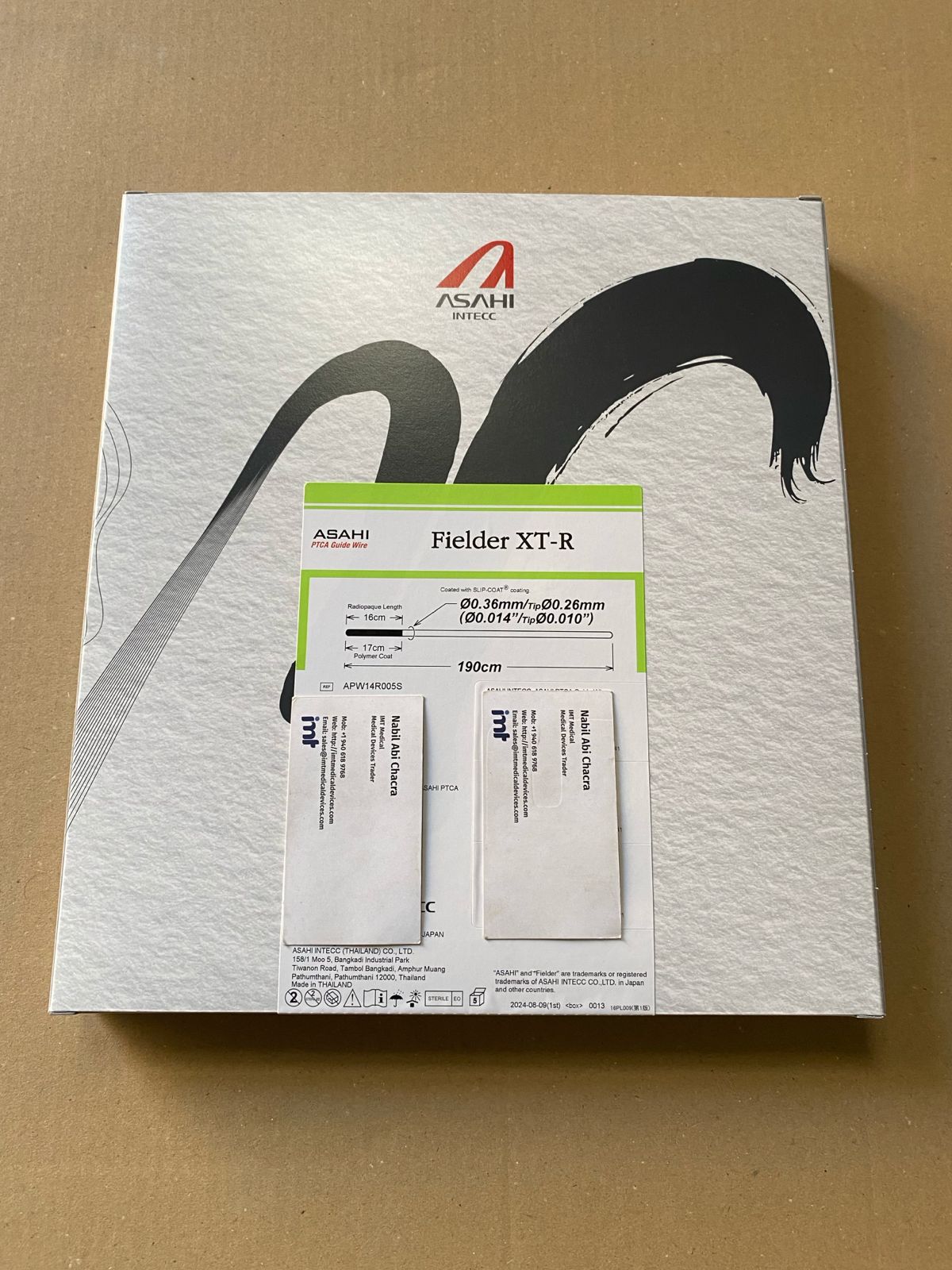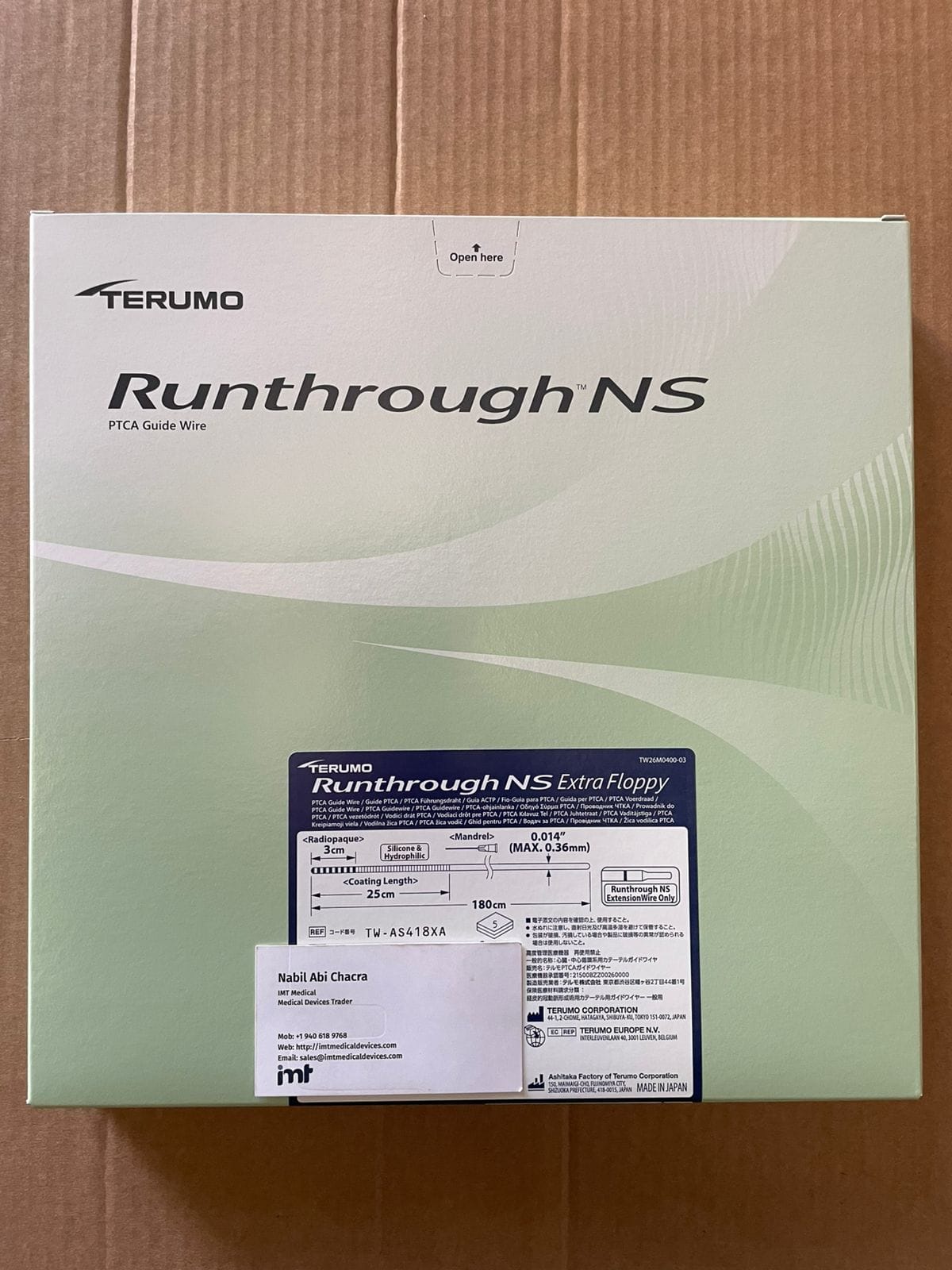


PTCA Balloon Catheters: A Technical and Procurement Guide for 2026
In 2026, a 12% delay in catheter delivery can disrupt an entire interventional cardiology schedule, yet 40% of international distributors still struggle with consistent lead times for premium brands. You understand that sourcing ptca balloon catheters requires more than a simple purchase order; it demands a partner capable of managing complex technical specs and global export hurdles. Procurement officers are right to prioritize inventory stability and technical accuracy when managing high-volume cardiac supplies.
This guide provides a technical breakdown of balloon mechanics and a strategic framework for B2B procurement across brands like Medtronic, Terumo, and Boston Scientific. We'll clarify the selection criteria between compliant and non-compliant options while highlighting our Export 50 Country logistics model. You'll gain a clear path to securing bulk international inventory with the speed and precision your facility requires. It's an essential resource for high-capacity medical supply chains. Product Details. Global reach. Technical precision.
Key Takeaways
- Analyze technical specifications of ptca balloon catheters to distinguish between pre-dilation and post-dilation clinical applications.
- Compare mechanical performance metrics, specifically pushability and trackability, for navigating complex coronary anatomy.
- Review the latest technical platforms and model performance from global manufacturers including Medtronic and Boston Scientific.
- Identify strategic sourcing protocols to ensure inventory stability and supply chain resilience for high-demand cardiology consumables.
- Optimize international procurement through established export channels and wholesale distribution frameworks for 2026.
Fundamentals of PTCA Balloon Catheters in Coronary Intervention
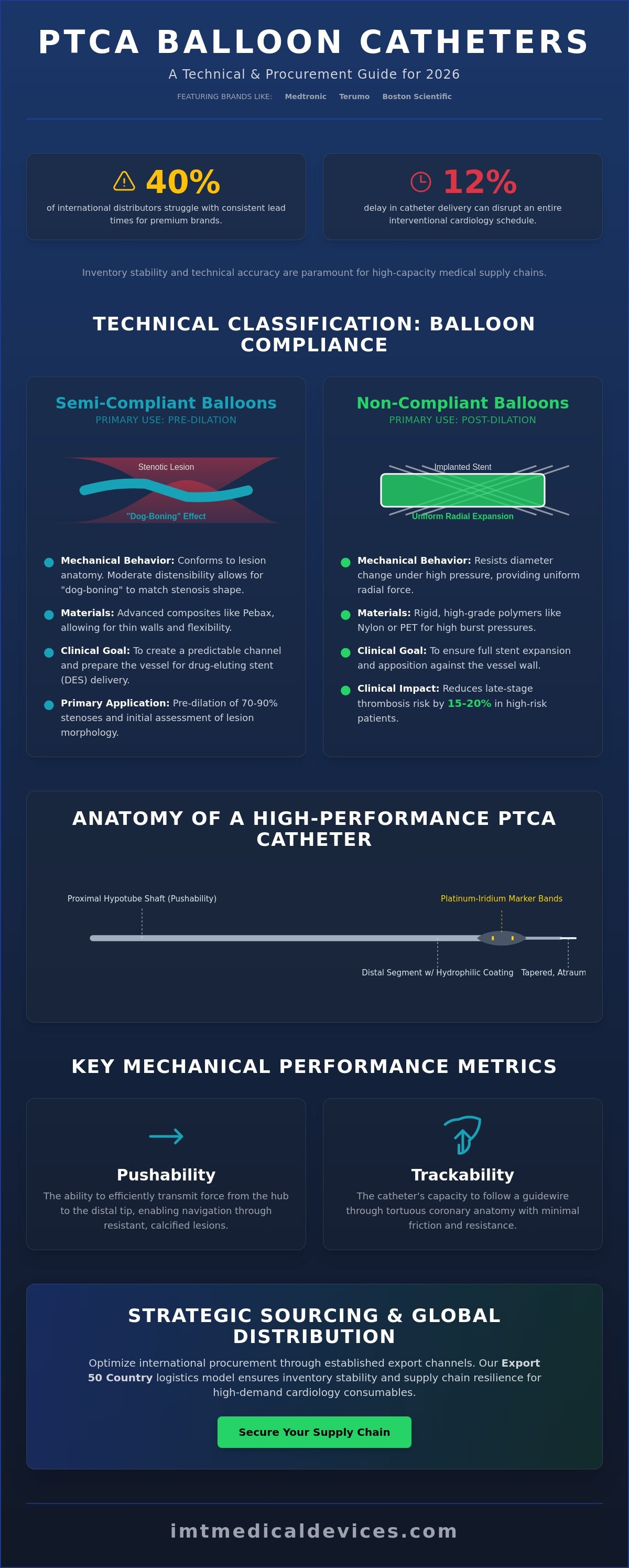
PTCA balloon catheters are specialized interventional tools designed for the mechanical dilation of narrowed coronary arteries. These devices facilitate the restoration of blood flow in patients with obstructive coronary artery disease. The technology has advanced significantly since the first procedure in 1977. Modern ptca balloon catheters utilize high-performance polymers and laser-bonding techniques to achieve superior burst pressures and minimal profiles. These catheters serve two primary clinical roles: pre-dilation of stenotic lesions to prepare the vessel for a stent and post-dilation of implanted stents to ensure full expansion.
The evolution of balloon materials reflects a shift toward precision engineering. Early polyethylene models have been replaced by advanced composites like Pebax and specialized nylon. These materials allow for thinner walls without sacrificing structural integrity. A catheter's crossing profile, often measuring less than 0.017 inches at the distal tip, determines its ability to navigate through tight, calcified blockages. Clinicians select these tools based on their compliance, trackability, and pushability. Understanding the Fundamentals of Percutaneous Coronary Intervention is essential for procurement teams evaluating these technical specifications for high-volume cardiac labs.
The Role of Balloons in Modern PCI Workflows
Current Percutaneous Coronary Intervention (PCI) protocols prioritize lesion preparation. Pre-dilation with semi-compliant ptca balloon catheters creates a predictable channel for drug-eluting stents (DES). This is vital in anatomy with 70% or greater stenosis. For complex cases involving calcification, high-pressure balloons provide the force necessary to fracture plaque. Post-dilation remains a critical step for improving stent apposition. Proper expansion reduces the risk of late-stage thrombosis by 15% to 20% in high-risk patients. Specialized balloon techniques are also standard in bifurcation lesions and chronic total occlusions (CTO) where precise vessel remodeling is required.
Anatomy of a High-Performance PTCA Catheter
The distal tip design is a primary differentiator in catheter performance. Tapered, atraumatic tips allow for seamless entry into narrow lesions. Transitionless profiles between the balloon and the shaft prevent "fish-scaling" during withdrawal. Shaft construction typically features a proximal stainless steel or Nitinol hypotube. This provides the pushability needed to transmit force from the manifold to the distal end. Precise positioning under fluoroscopy is managed through marker band placement. Most high-end models from manufacturers like Medtronic, Boston Scientific, and Terumo use platinum-iridium or gold marker bands for maximum visibility. Hydrophilic coatings are applied to the distal segment to minimize friction during navigation through tortuous distal anatomy.
Technical Classification: Compliant vs. Non-Compliant Balloons
Balloon compliance defines the predictable expansion of the device material relative to atmospheric pressure (atm). This mechanical property dictates how ptca balloon catheters interact with arterial walls and implanted stents. A Technical Review of PTCA Procedures indicates that selecting the correct compliance profile is critical for preventing vessel dissection or incomplete stent apposition. Procurement officers must distinguish between these categories to maintain stock for different procedural phases. The relationship between pressure and diameter is the primary metric for clinical safety.
Semi-Compliant Balloons for Pre-Dilation
Semi-compliant models are the primary choice for initial vessel entry. These devices utilize materials with moderate distensibility, allowing the balloon to "dog-bone" and conform to the anatomy of the stenosis. They're optimized for trackability and crossing profile. Operators use them to prep the vessel before stent delivery, ensuring the lesion can accommodate the hardware. These units are frequently stocked alongside specialized ptca balloon types to provide clinicians with versatile options for complex calcifications. Standard use cases include pre-dilation of 70-90% stenoses and assessment of lesion morphology in tortuous anatomy.
Non-Compliant Balloons for Post-Dilation
Non-compliant (NC) balloons feature rigid materials, typically high-grade nylon or PET, that resist diameter changes under high pressure. They're essential for "cracking" calcium and achieving full stent expansion against the vessel wall. Unlike semi-compliant versions, NC balloons maintain a uniform cylindrical shape even at 20 atm or higher. This prevents the "dog-bone" effect that can lead to edge dissections in healthy tissue. Procurement focus for NC balloons centers on high-pressure performance and puncture resistance in calcified environments.
- Nominal Pressure: The pressure at which the balloon reaches its labeled diameter, typically 6-8 atm.
- Rated Burst Pressure (RBP): The safety limit where 99.9% of units are statistically proven to remain intact.
Technical specifications for major brands (Verify RBP ranges):
- Medtronic NC Euphora: RBP 20 atm.
- Boston Scientific Emerge: RBP 14-20 atm.
- Terumo Hiryu: RBP 20 atm.
- Abbott NC Trek: RBP 20-22 atm.
- Cordis NC Empower: RBP 20 atm.
Clinicians don't swap these categories interchangeably. Precise diameter control at high atmospheres is the hallmark of the NC category, while flexibility defines the semi-compliant range. For bulk procurement of these essential interventional tools, view our wholesale coronary inventory for immediate export availability to over 50 countries.
Delivery Systems and Mechanical Performance Metrics
Mechanical performance determines the success of ptca balloon catheters in complex coronary interventions. Procurement teams evaluate three primary metrics: pushability, trackability, and crossability. Pushability defines the 1:1 force transmission from the proximal hub to the distal tip. High-performance catheters utilize 304V stainless steel hypotubes in the proximal shaft to prevent kinking. Trackability measures how the device navigates 90-degree bends in tortuous anatomy. This requires a transition zone between the stiff proximal shaft and the flexible distal segment. Crossability involves the entry profile and tip design. 2026 industry standards target lesion entry profiles as low as 0.016 inches for specialized micro-balloons.
Successful navigation during a Percutaneous Transluminal Coronary Angioplasty (PTCA) procedure depends on these mechanical variables. Friction reduction is mandatory for distal access. Hydrophilic coatings on the distal shaft reduce surface resistance by approximately 85% compared to uncoated surfaces. These coatings attract water molecules, creating a low-friction "slick" layer that facilitates movement through calcified vessels.
Rapid Exchange (RX) vs. Over-the-Wire (OTW) Systems
RX systems, or monorail catheters, dominate 90% of standard percutaneous coronary intervention (PCI) cases. They feature a short guidewire lumen at the distal 20cm to 30cm. This allows a single operator to exchange devices quickly without a 300cm extension wire. OTW systems utilize a full-length guidewire lumen. These are preferred for chronic total occlusions (CTO) because they provide superior guidewire support. OTW designs also allow for distal dye injection or wire exchange. Choice depends on lesion complexity; RX offers speed while OTW provides technical versatility in 150cm lengths.
Coating Technologies and Lubricity
Coating durability is a critical procurement specification for multi-pass procedures. Hydrophilic coatings perform best in blood-filled environments, providing maximum lubricity during delivery. Hydrophobic coatings, often silicone-based, repel moisture and are frequently used on the proximal shaft to improve handling for the operator. Advanced surface treatments minimize vessel trauma by reducing shear stress on the endothelium. Modern ptca balloon catheters from brands like Medtronic and Terumo use covalent bonding for coatings. This ensures the lubricant remains attached to the catheter during at least 5 passes through a rotating hemostatic valve, preventing embolic complications from coating delamination.
- Proximal Shaft: 1.8F to 2.2F diameter for kissing balloon techniques.
- Distal Tip: Laser-bonded, tapered designs for atraumatic crossing.
- Balloon Profiles: Folded diameters under 0.030 inches for 2.5mm balloons.
- Nominal Pressure: Standard 6 to 8 atm for semi-compliant models.
Comparative Analysis of Global Leading Brands
Global procurement for 2026 centers on four primary manufacturers: Medtronic, Boston Scientific, Terumo, and Abbott. These brands control over 75% of the international market for ptca balloon catheters due to their established clinical data and supply chain reliability. Selecting the right platform requires a deep dive into shaft mechanics, tip profiles, and expansion ratios.
Medtronic and Boston Scientific: Market Leaders
Medtronic's Sprinter Legend and NC Euphora platforms remain staples in catheterization labs worldwide. The Sprinter Legend is a semi-compliant workhorse featuring a 0.016-inch entry profile. It utilizes a multi-segment shaft design to maximize pushability. The NC Euphora focuses on non-compliant post-dilation, offering a high rated burst pressure of 20 atm. This ensures uniform stent apposition in rigid lesions.
Boston Scientific competes directly with the Maverick 2 and Emerge lines. The Emerge balloon utilizes proprietary laser bonding technology. This creates a seamless transition between the balloon material and the catheter shaft, which eliminates catch points. When comparing trackability within medtronic launcher compatible systems, Boston Scientific's Bi-Segment inner shaft often provides superior flexibility in tortuous distal anatomy.
Procurement departments in high-volume hospital systems prioritize these brands for several reasons:
- Fulfillment rates: Both brands maintained a 98% delivery reliability score in 2024.
- Compatibility: Standardized 0.014-inch wire compatibility across all models.
- Technical Support: Extensive clinical specialist networks available for complex PCI cases.
Specialized Solutions from Terumo and Abbott
Terumo focuses on radial access efficiency with the Takeru and Hiryu high-pressure balloons. Takeru is designed for crossability, featuring a hydrophilic coating that reduces friction by 30% compared to non-coated alternatives. The Hiryu balloon targets calcified lesions, maintaining its shape even at pressures exceeding 22 atm. These tools are essential for 5F and 6F radial systems where space is limited.
Abbott's Trek and NC Trek catheters are recognized for their precision. The NC Trek is a preferred choice for post-dilation because it exhibits a radial growth rate of only 0.5% between nominal and rated burst pressure. This stability prevents "dog-boning" and reduces the risk of edge dissections. It's common to utilize guiding catheter medtronic platforms, such as the Launcher or Sherpa NX, to deliver these Abbott balloons. The large internal lumens of these guides facilitate complex kiss-balloon techniques without friction.
Inventory managers must account for the 12% projected increase in complex coronary interventions for 2026. Maintaining a mix of Medtronic's pushability and Abbott's precision ensures labs are prepared for any anatomical challenge. Product details and model numbers must be cross-referenced to ensure compatibility with existing guide wires and manifolds.
Strategic Sourcing and Global Distribution of PTCA Catheters
IMT Medical Devices functions as a professional bridge between elite manufacturers and global healthcare providers. We specialize in the high-volume distribution of ptca balloon catheters from brands like Medtronic, Terumo, and Boston Scientific. Our operational model prioritizes supply chain resilience. This ensures that critical cardiology consumables remain available even during periods of high market volatility. By centralizing procurement, we eliminate the complexities of managing multiple vendor contracts.
B2B procurement through a single distributor offers measurable financial advantages. Consolidated shipping reduces freight expenses. Bulk pricing models allow hospitals to maximize their annual budgets. We provide access to a diverse brand variety. This allows clinicians to select specific tools for complex coronary interventions without switching suppliers. Our "Export 50 Country" badge represents a proven track record in global medical logistics.
Managing Bulk Procurement for Cardiology Labs
Inventory management for interventional suites requires precision. Labs must stock a full range of balloon sizes, typically ranging from 1.5mm to 4.5mm in diameter. IMT Medical Devices simplifies this through multi-brand wholesale sourcing. We provide a single point of contact for diverse product lines. Our "Export 50 Country" capability defines our logistical reach. We currently serve 50 international markets, delivering high-spec medical technology to regions with demanding procurement standards. This scale allows us to maintain consistent stock levels of best-selling models.
Logistics and Cold Chain Integrity
Sensitive interventional devices require specialized handling to maintain material integrity. While most ptca balloon catheters are shelf-stable, they're protected from extreme temperature fluctuations and physical compression during transit. We use reinforced packaging and monitored shipping lanes to ensure every unit arrives in sterile condition. Navigating international customs is a core competency. We manage all regulatory documentation, including CE marking verification and export certificates, to prevent delays. Our logistics team handles specific tariff codes and import duties for 50 different jurisdictions.
Efficiency in the medical supply chain saves lives. Professional procurement officers choose IMT for our industrial capacity and technical expertise. Contact IMT Medical Devices for bulk PTCA balloon catheter quotes to secure your 2026 inventory requirements.
Optimize Your 2026 PTCA Supply Chain Logistics
Precision in coronary intervention requires a rigorous approach to selecting compliant and non-compliant technologies. Technical data confirms that trackability and nominal pressure ratings are the decisive factors for procedural efficiency in 2026. Reliable procurement hinges on securing authentic components from industry leaders like Medtronic, Terumo, and Boston Scientific. IMT Medical Devices serves as a specialized bridge in the global medical supply chain, maintaining strategic distribution hubs in Dubai, Georgia, Turkey, and Poland. We facilitate the wholesale export of ptca balloon catheters to 50+ countries, ensuring that high-volume clinical requirements are met without delay. Our logistical infrastructure is built for rapid product dispatch and inventory transparency. Procurement officers can rely on our authorized distributor status to maintain inventory stability and technical excellence across all interventional departments. Partnering with a high-capacity distributor ensures your facility stays ahead of global demand shifts. We're ready to support your international medical supply needs with efficiency and precision.
Request a Wholesale Quote for PTCA Balloon Catheters
Frequently Asked Questions
What is the difference between compliant and non-compliant PTCA balloons?
Compliant balloons expand 10% to 20% beyond their nominal diameter as pressure increases, while non-compliant (NC) balloons maintain their shape with less than 5% growth. Use compliant models for initial lesion crossing and pre-dilation. Select NC balloons for high-pressure post-dilation and stent apposition to ensure uniform expansion without dog-boning effects that cause vessel trauma.
Which brands of PTCA balloon catheters does IMT Medical Devices export?
IMT Medical Devices exports premium ptca balloon catheters from global manufacturers including Medtronic, Terumo, Boston Scientific, and Cordis. Our inventory features high-demand models like the Emerge, Sprinter Legend, and Ryujin Plus. We facilitate wholesale distribution to 50 countries, ensuring rapid access to authentic inventory for international procurement officers and hospital networks seeking reliable logistical partners.
How do I choose between a 1.5mm and 2.0mm balloon for pre-dilation?
Choose a 1.5mm balloon for complex, calcified lesions or total occlusions where a low entry profile is critical for crossing. A 2.0mm balloon is standard for moderate stenoses where 70% vessel diameter coverage is required before stent deployment. Clinical data shows 1.5mm sizes reduce the risk of vessel trauma in small-vessel interventions under 2.5mm in diameter.
What are the advantages of using a Rapid Exchange (RX) delivery system?
Rapid Exchange (RX) systems allow a single operator to manage catheter swaps by using shorter 190cm guidewires. This configuration reduces procedural time by 15% compared to Over-the-Wire (OTW) systems. RX designs minimize radiation exposure for staff and simplify the logistics of complex multi-balloon PCI procedures. It's the preferred choice for 90% of standard interventional cases due to its efficiency.
Can PTCA balloons be reused after sterilization?
No, PTCA balloons are strictly single-use medical devices and can't be reused. Regulatory bodies like the FDA and CE mark standards prohibit re-sterilization due to risks of material fatigue and cross-contamination. Reusing a balloon increases the 2% baseline risk of device failure. This leads to potential balloon rupture or arterial wall dissection during high-pressure inflation cycles.
What documentation is required for the international export of medical catheters?
International export requires a Certificate of Free Sale (CFS), Commercial Invoice, Packing List, and a Certificate of Origin. We provide ISO 13485 compliant documentation for every shipment across our 50 country export network. Procurement teams must also verify local import permits and specific Ministry of Health registrations required for the 2026 regulatory cycle in their respective regions.
How does balloon profile affect the success of a PCI procedure?
A lower balloon profile, typically between 0.016 and 0.022 inches, directly increases the success rate of crossing tight stenoses. Low-profile ptca balloon catheters improve trackability through tortuous anatomy. Selecting a device with a 0.017-inch entry profile allows access to 95% of distal lesions that would otherwise be inaccessible with standard-profile equipment, ensuring higher procedural success rates.
What is the standard shelf life for sterile PTCA balloon catheters?
The standard shelf life for sterile PTCA balloon catheters is 2 to 3 years from the date of manufacture. This duration depends on the integrity of the Tyvek packaging and the stability of the hydrophilic coating. Inventory should be stored in climate-controlled environments at 15 to 30 degrees Celsius to prevent polymer degradation and ensure 100% performance reliability at the point of use.