PTCA Balloon Types: A Technical Comparison for Interventional Cardiology
A 0.016-inch difference in crossing profile determines the success or failure of complex lesion access in tortuous coronary anatomy. Selecting the correct ptca balloon types requires more than a basic understanding of diameter and length; it demands precise data on compliance curves and trackability. You already know that miscalculating the Rated Burst Pressure (RBP) or choosing the wrong material stiffness leads to suboptimal outcomes and increased procedure times. Precise inventory management is essential for maintaining procedural standards in high-volume cath labs.
This technical comparison provides a clear framework for inventory selection, focusing on high-performance metrics and specialized versus standard balloon roles. You'll find a breakdown of semi-compliant, non-compliant, and specialty balloons from premium manufacturers like Medtronic, Terumo, and Boston Scientific. We outline a reliable international sourcing route to streamline procurement for facilities in our Export 50 Country network. This guide ensures rapid information retrieval for procurement officers seeking high-capacity distribution and authentic medical technology.
Key Takeaways
- Distinguish functional roles for lesion preparation, stent delivery, and post-dilation optimization in Percutaneous Transluminal Coronary Angioplasty.
- Evaluate technical performance metrics across various ptca balloon types, focusing on atmospheric response and Rated Burst Pressure (RBP) thresholds.
- Identify specialized dilation technologies for complex lesion management, including Drug-Coated Balloons (DCB) and calcification-specific tools.
- Compare Monorail and Over-the-Wire (OTW) delivery systems to streamline catheter-guidewire interface and warehouse logistics.
- Optimize global procurement strategies to ensure regulatory compliance and cold chain integrity for international cardiology inventory.
Classification of PTCA Balloon Catheters in Coronary Interventions
PTCA balloon catheters are essential tools in the Percutaneous Coronary Intervention (PCI) workflow. These devices facilitate the mechanical expansion of narrowed coronary arteries to restore myocardial perfusion. In global medical logistics, identifying the correct ptca balloon types is a baseline requirement for procedural safety and inventory management. Selecting an inappropriate balloon diameter or material increases the risk of vessel dissection, a complication that occurs in approximately 5% to 10% of complex interventions. Professional procurement officers prioritize devices that balance pushability with a low entry profile to ensure successful lesion access.
Classification of these catheters follows three primary pillars: compliance, specialty function, and the delivery system. Compliance measures the balloon's ability to change diameter in response to increasing pressure, measured in atmospheres (atm). Specialty balloons incorporate blades or coatings for resistant lesions. The delivery system, typically categorized as Rapid Exchange (Rx) or Over-the-Wire (OTW), determines how the operator manages the guidewire during the procedure. Logistics providers like IMT Medical Devices focus on high-demand inventory from manufacturers such as Medtronic, Boston Scientific, and Terumo to meet these technical requirements.
The Role of Balloon Angioplasty in Modern PCI
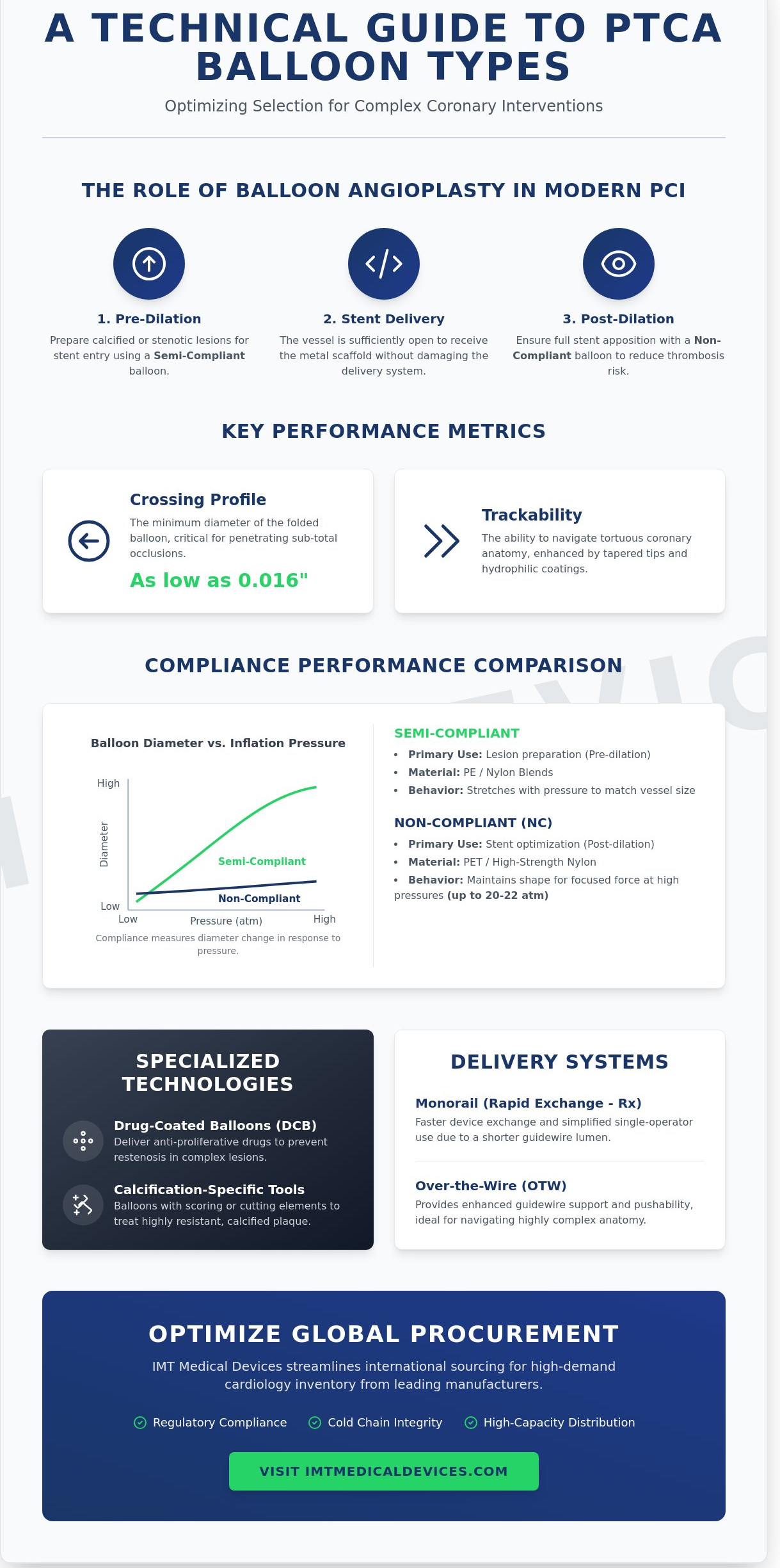
Pre-dilation is the first critical phase where a semi-compliant balloon prepares calcified or high-grade stenotic lesions for stent entry. This step ensures the vessel is sufficiently open to receive the metal scaffold without damaging the delivery system. Post-dilation follows stent deployment. It's a mandatory step for ensuring full stent apposition against the arterial wall, which reduces the 12-month risk of stent thrombosis. Non-compliant balloons are the standard for post-dilation because they maintain their shape under high pressures of 20 to 22 atm. Industry leaders, including Medtronic and Boston Scientific, dominate this sector with specialized balloons designed for high-pressure durability and uniform expansion.
Key Technical Metrics: Crossing Profile and Trackability
Product details for coronary balloons always highlight the crossing profile. This metric represents the minimum diameter of the folded balloon, often as low as 0.016 inches, required for penetration of sub-total occlusions. A lower crossing profile allows the device to reach distal lesions that larger catheters can't access. Trackability is the ability to navigate tortuous coronary anatomy. The success of complex interventions depends heavily on the distal tip design. Modern tapered tips and hydrophilic coatings reduce friction, allowing the balloon to glide through calcified segments. These technical specifications are vital for practitioners who don't want to risk device failure in the middle of a high-stakes procedure. IMT Medical Devices maintains a robust supply of these high-specification ptca balloon types to export to 50 countries, ensuring clinics have access to the latest technical advancements in coronary care.
Compliant vs. Non-Compliant Balloons: A Performance Comparison
PTCA balloon types are categorized by their compliance, which is the degree to which a balloon's diameter increases as internal atmospheric pressure (atm) rises. This mechanical property determines how the device interacts with the arterial wall. Clinicians rely on these metrics during a Clinical Overview of PTCA to select the correct tool for specific lesion morphologies. Every balloon has two critical safety thresholds: Nominal Pressure and Rated Burst Pressure (RBP). Nominal Pressure is the point where the balloon reaches its labeled diameter. RBP is the limit where there's a 99.9% statistical probability that the balloon won't burst. Selecting the wrong ptca balloon types for high-pressure tasks can lead to vessel trauma or device failure.
Material science dictates these performance differences. Compliant and semi-compliant balloons usually consist of Polyethylene (PE) or specialized Nylon blends. These materials allow for stretching. Non-compliant (NC) balloons utilize Polyethylene Terephthalate (PET) or high-strength Nylon. PET provides the structural rigidity needed to withstand high pressures without significant deformation. Logistics managers can find these specific coronary intervention supplies in our global export inventory.
Compliant and Semi-Compliant Balloons
Semi-compliant balloons are the standard choice for general lesion preparation. They provide a diameter increase of 10% to 20% from nominal pressure to RBP. This flexibility allows the balloon to conform to the vessel shape, making it ideal for initial dilation and pre-stenting maneuvers. Their high trackability is essential for reaching distal lesions or navigating tortuous anatomy. However, clinicians must monitor pressure closely. At high atmospheres, these balloons are prone to the "dog-boning" effect. This occurs when the balloon ends over-expand while the center remains constricted by the lesion. This creates a dumbbell shape that can cause unintended edge dissections in healthy tissue.
Non-Compliant (NC) Balloons for High-Pressure Dilation
NC balloons are designed for stability and force. They exhibit minimal diameter growth, typically less than 5% beyond nominal pressure. This ensures that the expansion force is directed outward against the lesion rather than longitudinally along the vessel. They're the primary choice for post-dilation of stents to ensure full apposition against the arterial wall. They're also vital for treating heavily calcified or resistant lesions that require pressures exceeding 20 atm. High-performance models include:
- Medtronic NC Euphora: Known for high RBP and excellent crossability in complex cases.
- Boston Scientific NC Emerge: Optimized for stent post-dilation with a focus on tip profile and trackability.
Product Details: Our distribution network facilitates the export of these premium brands to 50 countries. We prioritize technical specifications and RBP reliability to ensure medical facilities receive authentic, high-performance ptca balloon types for critical care environments.
Specialized PTCA Balloons for Complex Lesion Management
Standard dilation proves insufficient in approximately 25% of complex coronary interventions. Procedures involving heavy calcification or chronic total occlusions require advanced ptca balloon types designed for lesion modification rather than simple expansion. IMT Medical Devices facilitates access to these specialized technologies through a streamlined global supply chain. Our inventory includes high-performance devices from Medtronic, Boston Scientific, and Terumo, ensuring procurement officers can secure necessary stock for high-volume cardiac centers.
Cutting and Scoring Balloons
These devices utilize a mechanical approach to disrupt rigid plaque. Cutting balloons feature three to four microsurgical blades mounted longitudinally. Scoring balloons use nitinol wires to concentrate force. Clinical data indicates that Cutting Balloon Angioplasty creates controlled incisions in the vessel wall, which prevents uncontrolled dissections.
Product Details and benefits include:
- Mechanism: Focused force at the blade edge facilitates plaque fracture at lower inflation pressures.
- Application: Primary use in ostial lesions and fibrotic tissue where standard balloons slip or fail to expand.
- Clinical Outcome: Significant reduction in vessel recoil and a 12% to 15% improvement in final luminal diameter.
Drug-Coated Balloons (DCB)
The transition from mechanical modification to pharmacological treatment is essential for managing restenosis. DCBs deliver anti-proliferative drugs, typically Paclitaxel, directly to the intima during a 30 to 60-second inflation. This intervention suppresses neointimal hyperplasia without the need for permanent metal scaffolds. DCBs serve as a viable "stent-less" alternative for patients with small vessel disease or those at high risk for bleeding complications.
IMT Medical Devices specializes in the wholesale distribution of these ptca balloon types to over 50 countries. We focus on rapid fulfillment and technical accuracy.
Product Details for DCB applications:
- In-Stent Restenosis (ISR): The gold standard for treating narrowed stents.
- Small Vessel Disease: Effective for vessels under 2.5mm where stent thrombosis risks are higher.
- Logistics: Temperature-controlled shipping available for all pharmacological devices.
Delivery Systems: Monorail vs. Over-the-Wire (OTW) Configurations
The mechanical interface between the guidewire and the balloon catheter determines procedural efficiency and the level of support available during an intervention. Selection of ptca balloon types depends on the specific coronary anatomy and the required trackability. Delivery systems fall into two primary categories: Monorail and Over-the-Wire (OTW).
Global logistics for these systems require climate-controlled storage to maintain device integrity. Most PTCA balloons maintain a shelf-life of 2 to 3 years when stored between 10°C and 25°C. Inventory management focuses heavily on Monorail units, which currently account for approximately 90% of the global interventional market volume. This dominance stems from the design's ability to reduce procedure time by 10 to 15% compared to older configurations.
Monorail (Rapid Exchange) Systems
Monorail designs feature a guidewire entry point only at the distal portion of the catheter, typically the last 20 cm to 30 cm. This configuration allows a single operator to perform catheter exchanges without a second assistant. It's the standard for high-volume labs focusing on throughput and efficiency.
Product Details:
- Guidewire length: 190 cm standard.
- Exchange speed: 50% faster than OTW systems.
- Brand availability: Medtronic, Boston Scientific, Terumo.
Shorter guidewires used in Monorail systems reduce radiation exposure for the clinical team. This happens because the operator spends less time managing long wire lengths under active fluoroscopy. The primary limitation involves reduced pushability in extremely distal or tortuous vessels, as the wire doesn't provide support through the entire catheter shaft.
Over-the-Wire (OTW) Systems
The OTW design utilizes a guidewire lumen that runs the entire length of the catheter. This provides a coaxial platform for superior trackability and pushability. It remains the gold standard for complex cases where the physician needs maximum support to cross a lesion.
Primary use case: Chronic Total Occlusions (CTO).
- Advantages: Superior trackability; ability to exchange guidewires through the catheter lumen while maintaining the distal position.
- Logistical requirement: Requires 300 cm guidewires and two-person operation.
Physicians choose OTW configurations when they anticipate a need to swap wires mid-procedure without losing their hard-earned position across a calcified lesion. While these ptca balloon types are less common in routine cases, they are vital for 99% stenotic lesions where Monorail systems might buckle. The dual-lumen design also allows for the injection of contrast or medication directly through the catheter while the wire is in place.
Global Sourcing and Procurement of PTCA Balloons
Procuring medical hardware for cardiac departments requires a stable international supply chain. Hospitals in 50+ countries utilize wholesale distributors to maintain consistent stock levels. The availability of diverse ptca balloon types determines a facility's ability to treat complex coronary cases. Reliable logistics prevent delays in emergency interventional procedures. Procurement managers prioritize distributors that offer direct access to authentic, high-performance equipment.
Quality assurance remains the primary focus of global distribution. Every shipment must comply with ISO 13485 standards. This ensures product integrity from the manufacturer to the sterile supply room. Distributors manage temperature-controlled storage environments to protect sensitive materials. Precise batch tracking and shelf-life monitoring are standard protocols. These measures prevent the use of expired or compromised technology in the cath lab. It's a logistical necessity that demands high-level technical expertise.
Leading Brands in the PTCA Market
Medtronic dominates the inventory of many international hospitals. The Sprinter Legend semi-compliant series offers high trackability for tortuous anatomy. For high-pressure post-dilation, the Euphora non-compliant series is a standard choice. These models provide the tactile feedback and burst resistance required for modern interventions.
Terumo specializes in low-profile designs optimized for radial access. The Hiryu and Accuforce platforms are prominent in their portfolio. These devices feature hydrophilic coatings that reduce friction during delivery. Boston Scientific provides the Emerge and Maverick platforms. These cater to varied lesion morphologies, including highly calcified vessels. Procurement officers prioritize these brands for their proven clinical outcomes and reliability across different ptca balloon types.
Efficient B2B Procurement with IMT Medical Devices
IMT Medical Devices functions as a professional bridge between manufacturers and global healthcare providers. They offer bulk wholesale access to top-tier brands like Medtronic, Terumo, and Boston Scientific. The logistics team handles complex export documentation for shipments to 50+ countries. This expertise minimizes customs delays and ensures rapid delivery of critical inventory. It's an efficient solution for large-scale hospital networks.
Strategic inventory management allows hospitals to reduce overhead costs while maintaining high service standards. IMT Medical Devices provides a streamlined ordering process for high-volume purchasers. Their focus on transactional efficiency helps procurement managers secure the necessary hardware without logistical friction. Contact IMT Medical Devices for bulk PTCA balloon quotes to discuss international shipping options and product availability.
Streamlining Procurement for Advanced Coronary Interventions
Selecting the appropriate ptca balloon types remains a fundamental factor in interventional success. Procedural efficiency depends on matching balloon compliance to specific lesion morphology. Non-compliant balloons deliver the radial force needed for stent post-dilation, while semi-compliant options provide the flexibility required for initial predilation. IMT Medical Devices functions as a professional B2B partner for these critical supplies. We're an authorized wholesaler representing industry leaders Medtronic, Terumo, and Boston Scientific. Our logistics model utilizes strategic distribution hubs in Dubai, Georgia, Turkey, and Poland to maintain high-speed supply chains. We've established a proven track record, exporting medical technology to over 50 countries worldwide. This expansive reach ensures that procurement officers can secure authentic, high-performance catheters without delay. Our inventory focuses on technical specifications and immediate stock availability for global markets. It's time to strengthen your facility's supply chain with a reliable international distributor.
View our full inventory of PTCA Balloon Catheters and Cardiology Supplies
We look forward to supporting your clinical requirements with logistical excellence.
Frequently Asked Questions
What is the main difference between compliant and non-compliant PTCA balloons?
Compliant balloons expand 10 to 20 percent beyond nominal diameter as pressure increases, while non-compliant (NC) balloons maintain size with less than 5 percent growth. These distinct ptca balloon types serve different procedural roles. Operators use compliant types for pre-dilation and NC types for high-pressure post-dilation. NC balloons provide uniform radial force to ensure full stent apposition without over-expanding the vessel edges.
When should a drug-coated balloon (DCB) be used instead of a stent?
Drug-coated balloons (DCB) are indicated for in-stent restenosis (ISR) and small vessel disease where diameters are less than 2.5mm. Clinical data from the BASKET-SMALL 2 trial shows DCBs are non-inferior to drug-eluting stents in vessels under 3mm. This stent-less approach reduces long-term metallic burden in the coronary anatomy. It's an effective strategy for preventing recurrent narrowing without adding more permanent layers of metal.
What does "Rated Burst Pressure" (RBP) mean for a balloon catheter?
Rated Burst Pressure (RBP) is the maximum pressure at which 99.9 percent of balloons won't rupture. Manufacturers like Medtronic and Terumo establish this limit through rigorous bench testing. Standard RBP values for NC balloons typically range from 18 to 22 atmospheres (atm). Operators must monitor inflation via an indeflator to prevent vessel trauma or balloon failure. Exceeding the RBP increases the statistical risk of catastrophic device failure.
Are Monorail catheters better than Over-the-Wire systems?
Monorail catheters are the industry standard for 90 percent of coronary interventions because they allow faster balloon swaps and single-operator control. Over-the-Wire (OTW) systems provide superior trackability and support for complex total occlusions. OTW catheters allow for guidewire exchanges and distal contrast injections which monorail systems can't facilitate. Most labs stock both to handle varying lesion complexities and technical requirements.
Which brands are considered the gold standard for PTCA balloons?
Medtronic, Boston Scientific, and Terumo are the primary manufacturers for high-performance ptca balloon types. Specific models like the Emerge, NC Euphora, and Accuforce dominate global hospital inventory. IMT Medical Devices exports these authentic brands to 50 countries, ensuring access to original equipment manufacturer (OEM) specifications for global procurement. Our logistics network prioritizes rapid delivery of these specific product codes to international catheterization labs.
How do cutting balloons help in treating calcified coronary arteries?
Cutting balloons utilize 3 or 4 longitudinal micro-blades to create controlled incisions in calcified plaque at low pressures. This process reduces the dog-bone effect and vessel wall trauma during expansion. Research indicates that scoring or cutting techniques improve lumen gain in lesions where standard balloons fail to expand. These specialized tools are essential for treating resistant, fibro-calcific lesions that don't respond to conventional balloon angioplasty.
What is the standard diameter range for PTCA balloons in clinical use?
PTCA balloons feature a diameter range from 1.25mm to 5.0mm with typical lengths between 6mm and 30mm. Small 1.25mm to 2.0mm balloons serve as pre-dilation tools for tight stenoses. Larger 4.5mm and 5.0mm variants are reserved for left main or proximal vessel post-dilation. Precise sizing is mandatory to avoid vessel rupture, as a 0.5mm discrepancy can lead to significant clinical complications.