
Asahi CTO Guidewire Selection That Holds Up
A CTO case rarely fails because the team didn’t have “a wire.” It stalls because the wrong wire is on the table for the specific cap, the specific course, and the actual support setup in that room. That is what makes Asahi CTO guidewire selection a procurement topic as much as a technique topic: wire choice drives swaps, swaps drive time, and time drives consumption and backorders.
This guide is written for cath lab and supply chain teams who need repeatable stocking logic and clean ordering decisions - without trying to turn purchasing into an operator’s art project. The goal is fewer “we ran out of the one they actually use” moments, and fewer cases where half a drawer gets opened to find a path forward.
What drives Asahi CTO guidewire selection
In a practical stocking framework, CTO wire selection comes down to three variables that show up on every case worksheet: the proximal cap behavior, lesion course ambiguity, and available support (guide, extension, microcatheter). If you map those variables to a small set of Asahi wire families, you can cover most operator preferences without carrying every option.
The proximal cap matters because penetration is not the same as navigation. A hard, blunt cap tends to reward higher tip load and better tactile transmission. A tapered cap with microchannels can often be entered with a lower tip load if the wire can find the channel and track without prolapsing.
Course ambiguity matters because the best penetrating wire can still be the wrong first choice if the team is trying to stay intraluminal. If the vessel path is uncertain, a wire that communicates feedback and holds a controlled curve can reduce early subintimal entry and re-entry escalation.
Support matters because wires do not behave the same in isolation as they do through a microcatheter with consistent back-up. If your lab standardizes microcatheters and guide extension use, you can more confidently standardize wires. If support is variable, stocking needs more redundancy, because operators will compensate with wire choice.
Organizing the Asahi CTO lineup by job, not by marketing category
For purchasing decisions, it helps to group Asahi CTO wires into “jobs” that map to case progression. This keeps inventory aligned to how wires are actually consumed.
Job 1: Controlled probing and channel tracking
This is the wire category that gets opened early when the plan is to feel for microchannels, stay controlled, and avoid burning time with repeated prolapse. In many labs, this is where softer polymer-jacketed workhorse CTO wires live.
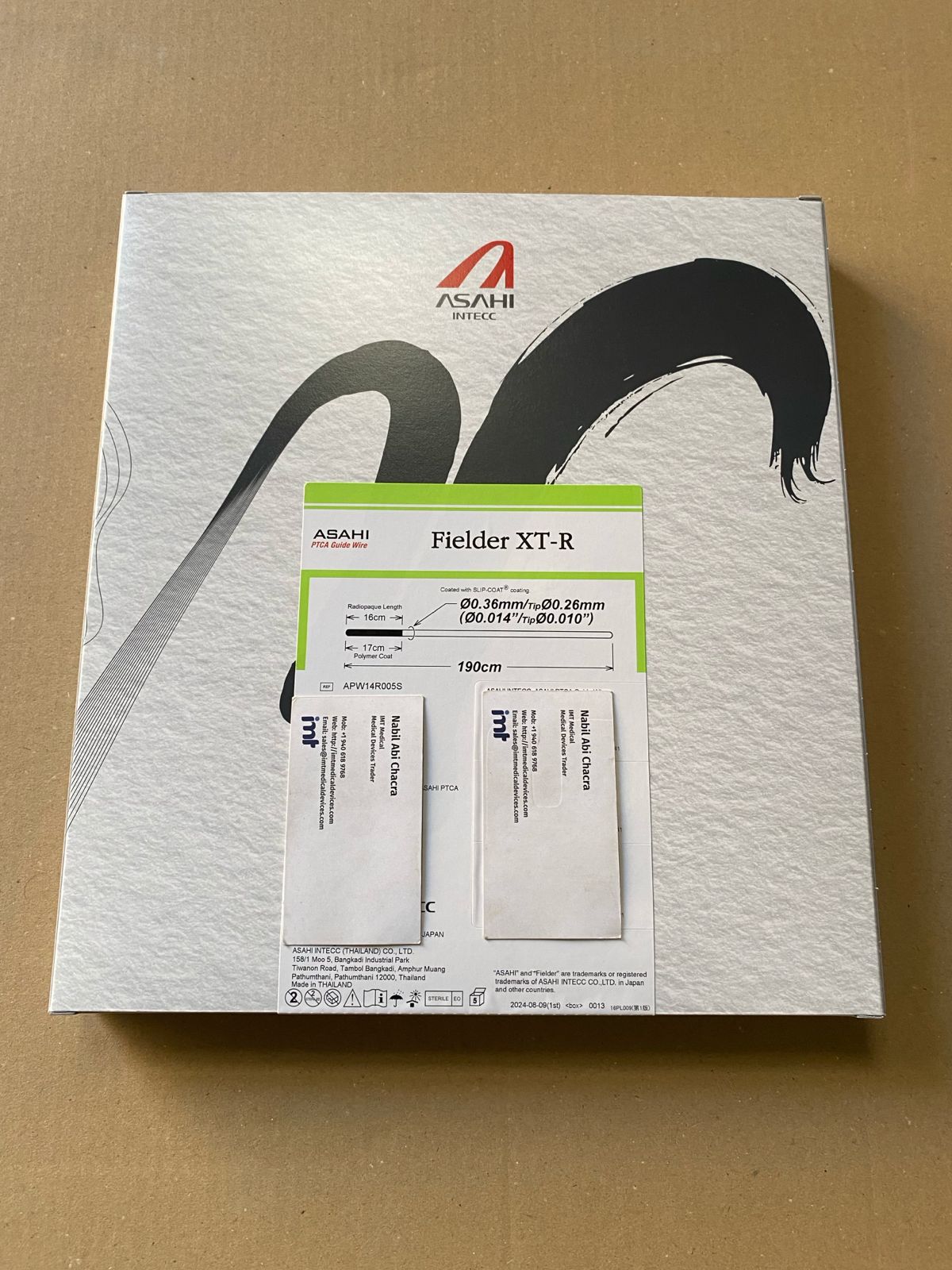
Asahi Fielder XT and Fielder XT-A are common selections for this job, especially when the operator wants a wire that can seek channels and advance with low resistance. From a stocking view, the decision is usually not “which one is better,” but which one is preferred by your physicians for initial wiring and for retrograde collateral work. If your program runs frequent retrograde attempts, these wires often move faster than expected.
Trade-off: polymer-jacketed wires can track quickly, but they can also mask feedback. If your operators frequently switch out early to regain tactile sense, that signals you may need stronger standardization on the next job category.
Job 2: Tactile, steerable escalation for ambiguous course
When the course is uncertain or the team wants to bias intraluminal progression, the wire needs to transmit feedback and hold a shaped tip without feeling “dead.” In Asahi terms, this is where Gaia-series wires typically show up in escalation ladders.
In day-to-day stocking conversations, Gaia First, Gaia Second, and Gaia Third are often treated as a set because many operators think in steps rather than in single-wire preference. If you only stock one, cases tend to open two anyway because operators escalate within the family to match resistance. If you stock the set, you can better predict consumption and reduce ad hoc substitutions.
Trade-off: tactile escalation wires do not solve a blunt cap by themselves if penetration is the limiting factor. When a case repeatedly “bounces,” the correct operational response is usually to move to a penetration-focused wire, not to keep reshaping and re-advancing.
Job 3: Penetration of hard proximal caps
This is the category that directly affects case efficiency because unsuccessful cap entry burns devices: more microcatheter exchanges, more guide extension time, and more wire tips sacrificed. For many programs, Asahi Confianza PRO 12 is the recognizable penetration wire that gets pulled when the cap is truly resistant.
From a procurement standpoint, penetration wires should be stocked with clear internal rules: who opens them, when they are opened, and what support is required (microcatheter and stable guide position). These rules reduce waste and avoid the pattern where a high tip-load wire is opened early without the support required to use it safely.
Trade-off: penetration wires can increase perforation risk if used without technique discipline and imaging context. That is a clinical governance point, but it becomes a supply point when teams respond to “we had a scare” by refusing to stock the wire, then compensating with inefficient swaps.
Job 4: Re-entry and specialized problem solving
Some CTO programs prefer to include a small amount of specialized inventory for re-entry strategy or very specific anatomy problems. This is where you see wires selected to support dissection/re-entry workflows, or to navigate challenging bends while maintaining push.
Not every lab needs to stock deep here. What matters is whether your physicians routinely perform these strategies, and whether they demand a specific Asahi wire by name. If the answer is yes, you stock it in low quantity but with high availability. If the answer is no, you avoid building a shelf of low-turn SKUs that expire.
A procurement-first stocking framework for CTO wires
If you are managing multiple operators, the best inventory is rarely “the biggest inventory.” The best inventory is the smallest set that reliably covers the first wire, the planned escalation path, and the bailout.
Start by defining your standard escalation ladder in terms of jobs: a channel-seeking starter, a tactile escalation step, and a penetration wire. If your physicians already use a ladder, your job is to capture it and translate it into SKUs and par levels. If they do not, you can still standardize by asking a simple question: “In a routine antegrade attempt, what do you want opened first, second, and third if the first two fail?”
Then align ladder choices to microcatheter compatibility. CTO wires are typically paired with dedicated microcatheters, and the “wire that works” is often actually a wire-and-microcatheter behavior. Standardizing the microcatheter set across rooms reduces the variability in wire performance and reduces the tendency to blame supply when the real issue is inconsistent support.
Finally, decide what you will not stock. This is uncomfortable, but it is how you prevent inventory drift. If a wire is used once a quarter and only by one physician, you either commit to stocking it with the right par level and expiration monitoring, or you set the expectation that it will be ordered as-needed with lead time.
Avoiding the most common selection and inventory errors
The first error is stocking only penetration wires because they are “the CTO wires.” That leads to overuse, wasted devices, and inconsistency. CTO work is usually won earlier with controlled probing and tactile progression, then escalated to penetration when the cap demands it.
The second error is stocking too many near-duplicates. If two wires do the same job in your operators’ hands, you do not gain coverage - you gain indecision and higher SKU complexity. This shows up as partial boxes everywhere and unpredictable reorder timing.
The third error is separating clinical preference from ordering data. If your purchasing system shows steady demand for Gaia-series wires but your team keeps running out of Fielder XT/XT-A, that is a workflow signal: the starter wire is being used more broadly than intended, or operators are using it for retrograde work that is not being flagged in your demand planning.
Standardization that still respects physician preference
Most cath labs do not need one universal wire. They need one universal logic. You can support physician preference by standardizing on families and steps, then allowing one “preference substitution” per step.
For example, you might carry one channel-seeking starter as the default and one alternative for a second operator, but you keep the tactile escalation and penetration wire consistent. That keeps case carts predictable and keeps purchasing from carrying three versions of every step.
If you are building a new CTO program or expanding volume, bias toward consistency first. Once your monthly run rate is stable, add breadth selectively based on documented usage, not hypothetical future cases.
Quote-driven sourcing when exact Asahi wires matter
CTO programs are sensitive to exact identifiers - not just the manufacturer, but the specific wire name, length, and tip behavior that a physician expects. If your facility is consolidating vendors or supporting cross-border supply continuity, use a sourcing workflow that starts with the exact requested wire and maps substitutions only with physician sign-off.
If you are already managing branded interventional inventory across coronary, peripheral, and neuro categories, consolidating requests through a single catalog can reduce ordering friction and shorten the cycle from “we need this wire for next week” to “it is on the shelf.” IMT Medical Devices supports quote-based purchasing and export sourcing for branded interventional disposables through its catalog at https://imtmedicaldevices.com.
Closing thought
The most reliable way to reduce CTO wire chaos is to treat Asahi CTO guidewire selection as a repeatable ladder tied to your support setup, then stock to that ladder with disciplined par levels. When the room is standardized, the case is faster, and the reorder pattern becomes predictable enough to manage instead of chase.