
Cost-Benefit Analysis of PTCA Balloon Catheters: A 2026 Procurement Guide
The lowest unit price on a procurement spreadsheet often represents the highest risk to a cardiology department's bottom line. It's a mistake to prioritize invoice costs over procedural throughput and clinical success. A rigorous cost-benefit analysis of PTCA balloon catheters reveals that premium hardware from manufacturers like Medtronic or Terumo reduces the total cost per case by minimizing procedural delays and equipment failures.
Budget constraints shouldn't force a compromise on clinical reliability. Procurement teams often struggle to justify high-end hardware despite the clear link between equipment quality and lab efficiency. This 2026 guide provides a technical framework for evaluating ROI based on current market data and regulatory shifts, including the FDA's Quality Management System Regulation (QMSR) transition to ISO 13485:2016. You'll find a clear strategy for optimizing inventory, leveraging global logistical hubs, and selecting hardware that balances technical precision with industrial-scale availability. We analyze how reliable sourcing of brands like Boston Scientific and Asahi Intec prevents the costly interruptions that define inefficient supply chains.
Key Takeaways
- Transition from unit-price procurement to Value-Based Healthcare (VBHC) models to align cardiology budgets with long-term clinical outcomes.
- Identify hidden procedural expenses by executing a technical cost-benefit analysis of PTCA balloon catheters that accounts for trackability and cath-lab time usage.
- Evaluate the ROI of specialty balloons versus conventional units, justifying premium hardware for complex calcified lesions to reduce secondary intervention rates.
- Minimize capital lock-up and avoid procedural delays by optimizing lead times through established international logistical hubs in Dubai, Turkey, and Poland.
- Secure a reliable supply chain for premium brands like Medtronic, Terumo, and Boston Scientific to ensure inventory availability and procedural consistency.
Economic Framework for PTCA Balloon Procurement in 2026
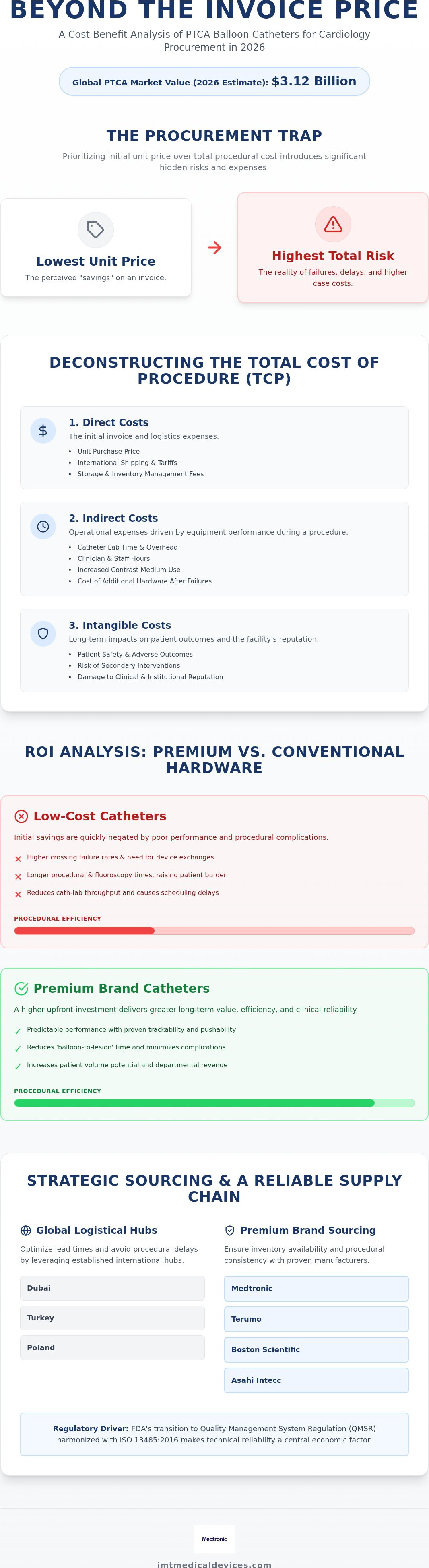
Procurement in interventional cardiology has evolved beyond simple invoice reconciliation. In 2026, a comprehensive cost-benefit analysis of PTCA balloon catheters is essential for maintaining lab throughput and financial stability. The global PTCA balloon catheter market reached an estimated value of $3.12 billion this year, driven by a shift toward Value-Based Healthcare (VBHC) models. These models prioritize clinical outcomes and procedural efficiency over the initial unit price of hardware. Procurement officers must now account for market drivers like logistical surcharges and the FDA's transition to the Quality Management System Regulation (QMSR) which became effective on February 2, 2026. This regulatory shift harmonizes international standards, making the technical reliability of components a central economic factor.
The standard metric for financial evaluation is now the Total Cost of Procedure (TCP). This calculation integrates the acquisition cost of the balloon with the operational expenses incurred during Percutaneous coronary intervention (PCI). If a low-cost balloon fails to cross a lesion or requires multiple exchanges, the resulting laboratory downtime and increased use of contrast medium quickly negate any upfront savings. Effective procurement requires a transition from price-tag shopping to a holistic assessment of hardware performance under clinical pressure.
Defining the Core Variables of Balloon CBA
A functional CBA framework categorizes costs into three distinct streams. Direct costs include the unit purchase price, international shipping, and storage fees. Indirect costs are more complex, encompassing procedural time, catheter lab overhead, and clinician hours. Every minute of lab time carries a specific overhead cost that must be amortized across the procedure. Intangible costs involve patient safety outcomes and the facility's clinical reputation. High failure rates with inferior hardware lead to longer recovery times and potential secondary interventions, which damage the long-term economic viability of the cardiology program.
The Role of Brand Reliability in Economic Forecasting
Manufacturer reputation serves as a primary risk-mitigation tool in 2026 procurement. Brands like Medtronic and Terumo provide predictable performance profiles that stabilize departmental budgets. The cost of a single balloon rupture or crossing failure can exceed the price of the device tenfold when accounting for additional hardware and extended staff time. Sourcing high-quality coronary intervention hardware ensures that procedural timelines remain within forecasted limits. By selecting premium balloons with proven trackability, procurement teams reduce the statistical likelihood of equipment-related delays. This pragmatic approach to inventory management prioritizes industrial-scale reliability and technical precision over short-term price concessions.
Direct vs. Indirect Costs: Beyond the Invoice Price
The invoice price of a PTCA balloon is a deceptive metric. A comprehensive cost-benefit analysis of PTCA balloon catheters must account for the secondary expenses generated by equipment performance. Low-cost catheters often lack advanced hydrophilic coatings or optimized tip profiles. These technical deficiencies result in crossing failures and the need for multiple device exchanges. Each exchange increases the consumption of contrast medium and extends fluoroscopy time, raising the physiological burden on the patient and the financial burden on the facility.
Device failure directly impacts hospital throughput. If a balloon fails to dilate a calcified lesion, the lab schedule shifts, potentially delaying subsequent cases. This bottleneck reduces bed turnover rates and limits the department's ability to maximize revenue. Reliable hardware from manufacturers like Boston Scientific or Terumo ensures predictable procedural durations. Consistent performance allows for tighter scheduling and higher patient volume without increasing staff overtime.
Cath-Lab Time as a Financial Variable
Operating a modern cardiac catheterization lab involves significant fixed and variable costs, including specialized nursing staff, technicians, and high-tech imaging maintenance. Premium catheters reduce 'balloon-to-lesion' time through superior pushability and crossability. This efficiency is a critical component in any cost-benefit analysis of PTCA balloon catheters. Reducing procedure time by 10 minutes through superior device trackability generates a measurable decrease in facility operational expenditure and increases daily patient capacity.
The Financial Burden of Procedural Complications
Procedural complications represent the most significant indirect cost in interventional cardiology. Balloon rupture or vessel dissection requires immediate remedial action. This often involves the deployment of additional coronary stents or, in severe cases, emergency surgical intervention. These 'bail-out' scenarios consume expensive inventory and extend hospital stays, negating the savings of cheaper hardware.
Long-term economic data indicates that high-quality initial dilation reduces the risk of restenosis. Lower restenosis rates mean fewer readmissions and secondary procedures. Facilities that prioritize premium hardware experience more stable budgeting by avoiding the volatility of complication-related expenses. For procurement officers seeking to stabilize these variables, sourcing through an established global distributor provides access to the necessary technical specifications for high-stakes procedures.
ROI Analysis: Conventional vs. Specialty PTCA Balloons
A comprehensive cost-benefit analysis of PTCA balloon catheters requires a clear distinction between standard workhorse equipment and specialty hardware. Semi-compliant balloons remain the primary choice for initial lesion access and predilatation due to their flexibility. However, non-compliant (NC) balloons are technically mandatory for high-pressure post-dilatation. Using a standard balloon for stent expansion often results in "dog-boning," where the balloon expands at the ends but not in the center. This leads to malapposition and increased thrombosis risk, creating a financial liability that far exceeds the price difference of an NC unit.
The "Premium Gap" is best understood through procedural success rates. A specialty balloon priced at a premium compared to a conventional unit becomes the more economical choice if it eliminates the need for secondary devices. For instance, the Wolverine Cutting Balloon provides controlled plaque modification in calcified lesions. This precision reduces the likelihood of vessel dissection, which would otherwise require additional stents and extended hospital stays. In these scenarios, the higher upfront investment acts as an insurance policy against procedural escalation.
Specialty Balloon Performance Metrics
Drug-Coated Balloons (DCB) represent a significant shift in ROI calculations. While the initial investment for a device like the B.Braun SeQuent Neo is higher than standard balloons, the reduction in target lesion revascularization (TLR) provides substantial long-term savings. DCBs are particularly effective in small vessel disease and in-stent restenosis where traditional stenting might be contraindicated. High-pressure NC balloons also contribute to ROI by ensuring definitive lesion expansion in a single inflation, minimizing the total number of catheters used per case.
Standardization vs. Customization in Procurement
Efficient inventory management relies on balancing clinical versatility with SKU reduction. Standardizing on high-performance platforms from manufacturers like Medtronic or Boston Scientific allows for bulk procurement advantages and simplified staff training. Reducing the number of unique identifiers in the cardiology department lowers administrative overhead and prevents capital lock-up in slow-moving inventory. Procurement strategies in 2026 prioritize versatile hardware that can handle a wide range of lesion morphologies, maximizing the utility of every stocked unit. This approach ensures that the cost-benefit analysis of PTCA balloon catheters accounts for both clinical outcomes and logistical simplicity.
Strategic Sourcing: Logistical Impact on Total Cost
Logistical efficiency is a primary variable in a modern cost-benefit analysis of PTCA balloon catheters. Procurement departments often overlook the financial burden of extended lead times and capital lock-up. When inventory remains in transit for weeks, it represents dead capital that cannot be utilized for other clinical needs. For high-volume PCI centers, the cost of a stockout is even more severe. If a procedure is delayed or canceled due to the absence of a specific non-compliant balloon size, the fixed overhead of the catheterization lab continues to accrue without generating revenue. This operational friction significantly increases the total cost of ownership for cardiology hardware.
Navigating international trade regulations and customs in 2026 requires specialized expertise. The transition to the FDA's Quality Management System Regulation (QMSR) has tightened documentation requirements for medical device exports. Inefficient handling of these regulatory hurdles leads to customs delays and potential device degradation if climate-controlled conditions aren't maintained. Leveraging a global wholesaler allows facilities to consolidate their procurement of brands like Medtronic, Boston Scientific, and Terumo, reducing the administrative complexity of managing multiple international accounts.
Optimizing the Supply Chain for Venezuela and Global Markets
IMT Medical Devices utilizes regional distribution hubs in Dubai, Turkey, and Poland to minimize transit-related expenses. These strategic locations allow for rapid deployment of inventory to over 50 countries, including Venezuela. Maintaining device integrity is paramount, particularly for drug-coated balloons that require specific environmental controls. Professional logistics management ensures that all documentation is pre-cleared, preventing the costly storage fees and procedural interruptions associated with regulatory non-compliance.
Wholesale Procurement Strategies
Centralized sourcing provides several financial advantages over piecemeal ordering. By aggregating demand, procurement teams can access better pricing tiers for PTCA balloon catheters and related hardware. Consolidated shipping also reduces the total landed cost per unit by spreading freight and insurance expenses across a larger volume of goods. Centralizing procurement through a single wholesaler like IMT eliminates the administrative burden of multiple vendor payments and significantly reduces the cumulative cost of international wire transfers and transaction fees.
To ensure consistent access to premium cardiology technology without the volatility of fragmented supply lines, hospitals can partner with a global distributor to stabilize their procurement cycles. This strategic alignment ensures that a cost-benefit analysis of PTCA balloon catheters accounts for the hidden savings of logistical reliability and supply chain security.
Conclusion: Optimising Cardiology Budgets with Premium Brands
A rigorous cost-benefit analysis of PTCA balloon catheters in 2026 confirms that technical quality is the most effective hedge against laboratory budget volatility. Procurement managers must move beyond the unit-price paradigm to embrace Total Cost of Ownership (TCO) models. High-volume PCI centers require hardware that guarantees crossing success and vessel preparation efficiency. Premium brands, specifically Medtronic, Boston Scientific, and Terumo, provide the necessary engineering tolerances to maintain high throughput and minimize procedural complications. It's no longer viable to ignore the downstream costs of inferior equipment performance.
The Value Proposition of Manufacturer Authenticity
Authenticity in the medical supply chain is a critical economic factor. Sourcing through authorized wholesale channels eliminates the technical and legal risks associated with grey-market hardware. Legitimate supply lines ensure that every PTCA balloon maintains its structural integrity and coating performance from the factory to the cath-lab. For global partners, this reliability is anchored by the IMT Medical Devices distribution network, which prioritizes manufacturer-direct provenance. This transparency secures access to essential technical support and warranty protections that are completely absent in fragmented or unauthorized sourcing models. Ensuring device integrity isn't just a clinical requirement; it's a financial necessity for predictable budgeting.
Actionable Steps for 2026 Procurement
Implementing a Value-Based CBA requires immediate, data-driven adjustments to current purchasing workflows. Procurement managers should follow these strategic steps to optimize departmental spend and improve procedural ROI:
- Audit Procedural Success: Identify correlations between device failure rates and specific manufacturer codes to pinpoint high-cost hardware.
- Consolidate Demand: Requesting consolidated quotes for Medtronic or Terumo bulk supplies to leverage high-volume wholesale pricing tiers.
- TCO Tracking: Deployment of tracking systems for all cardiology consumables, accounting for lab time, contrast medium, and secondary device usage per case.
- Logistical Optimization: Utilizing established hubs in Dubai, Turkey, or Poland to reduce lead times and minimize capital lock-up in slow-moving inventory.
The final recommendation for 2026 is clear. Standardizing on premium, authentic cardiology supplies from global leaders ensures clinical excellence and financial predictability. By aligning procurement with a rigorous cost-benefit analysis of PTCA balloon catheters, facilities protect their operational margins while delivering superior patient care. Reliable sourcing through experienced distributors provides the bridge between innovative technology and industrial-scale availability.
Standardizing Your 2026 Procurement Strategy
A data-driven cost-benefit analysis of PTCA balloon catheters confirms that technical reliability is the primary driver of departmental ROI. Transitioning to value-based healthcare models requires a shift from unit-price accounting to a total cost of procedure approach. You've seen how premium hardware reduces indirect expenses like cath-lab downtime and complication-related hardware consumption. Quality hardware acts as a hedge against budget volatility.
Securing a stable supply chain is the final step in protecting your cardiology budget. IMT Medical Devices provides a vital bridge between prestigious manufacturers and international markets. We offer wholesale pricing for Medtronic, Boston Scientific, and Terumo hardware through specialized logistical hubs in Dubai and Europe. Our export capabilities reach over 50 countries, including Venezuela, ensuring device integrity through professional handling and regulatory compliance.
Don't let fragmented sourcing or inferior equipment compromise your clinical outcomes. Request a Wholesale Quote for PTCA Balloon Catheters to stabilize your inventory and reduce procedural costs today. We're ready to help you optimize your cardiology department's financial and clinical performance.
Frequently Asked Questions
What is the primary cost-benefit of using non-compliant PTCA balloons?
Non-compliant balloons provide uniform expansion at high pressures to prevent stent malapposition. This clinical precision reduces the risk of stent thrombosis and subsequent emergency readmissions. Avoiding these complications stabilizes the departmental budget by eliminating the need for expensive secondary interventions and prolonged hospital stays.
How do specialty cutting balloons impact long-term hospital costs?
Specialty cutting balloons provide precise plaque modification in calcified lesions. This technical capability reduces the incidence of vessel dissection and the resulting need for bail-out stenting. Fewer complications mean lower inventory consumption and shorter procedural times; which directly improves laboratory throughput and financial efficiency.
Is the reuse of PTCA balloon catheters a viable cost-saving strategy in 2026?
Balloon reuse is not a viable strategy under the 2026 regulatory framework. The FDA's Quality Management System Regulation (QMSR); effective February 2; 2026; mandates strict adherence to ISO 13485:2016 standards. Reuse increases the risk of mechanical failure and cross-contamination; creating legal and clinical liabilities that far outweigh any initial savings on hardware.
What are the indirect costs associated with low-quality balloon catheters?
Indirect costs include extended procedural time and increased consumption of contrast medium. A cost-benefit analysis of PTCA balloon catheters demonstrates that crossing failures with inferior hardware lead to higher laboratory overhead and staff overtime. These hidden expenses often negate the lower upfront invoice price of non-premium brands.
How does international shipping and logistics affect the price of cardiology supplies?
International logistics impact the landed cost through freight; insurance; and customs documentation fees. Efficient sourcing through regional hubs in Dubai or Europe minimizes transit times and prevents capital lock-up in slow-moving inventory. Professional handling also ensures device integrity for drug-coated balloons that require specific environmental controls.
Can bulk procurement from a wholesaler like IMT reduce my per-unit cost?
Bulk procurement through an authorized wholesaler provides access to volume-based pricing tiers for brands like Medtronic and Terumo. Centralizing orders for multiple product categories also reduces the cumulative cost of international transaction fees and administrative overhead. This strategy ensures a more predictable expenditure profile for high-volume PCI centers.
What brands provide the best trackability-to-price ratio for complex lesions?
Medtronic; Terumo; and Boston Scientific offer the most reliable trackability benchmarks for complex anatomy. Their specialized hydrophilic coatings and optimized tip profiles ensure crossing success; which reduces the total number of devices used per case. Selecting these manufacturers minimizes the financial risk of procedural delays and equipment-related failures.
How should a hospital calculate the ROI of Drug-Coated Balloons (DCB)?
ROI for Drug-Coated Balloons is calculated by comparing the initial device cost against the reduction in target lesion revascularization (TLR) rates. While the unit price is higher than standard balloons; the decrease in readmission rates for in-stent restenosis provides significant long-term savings. This assessment is a critical component of a modern cost-benefit analysis of PTCA balloon catheters.