
Consolidating Medical Device Vendors: A Strategic Guide for 2026 Procurement
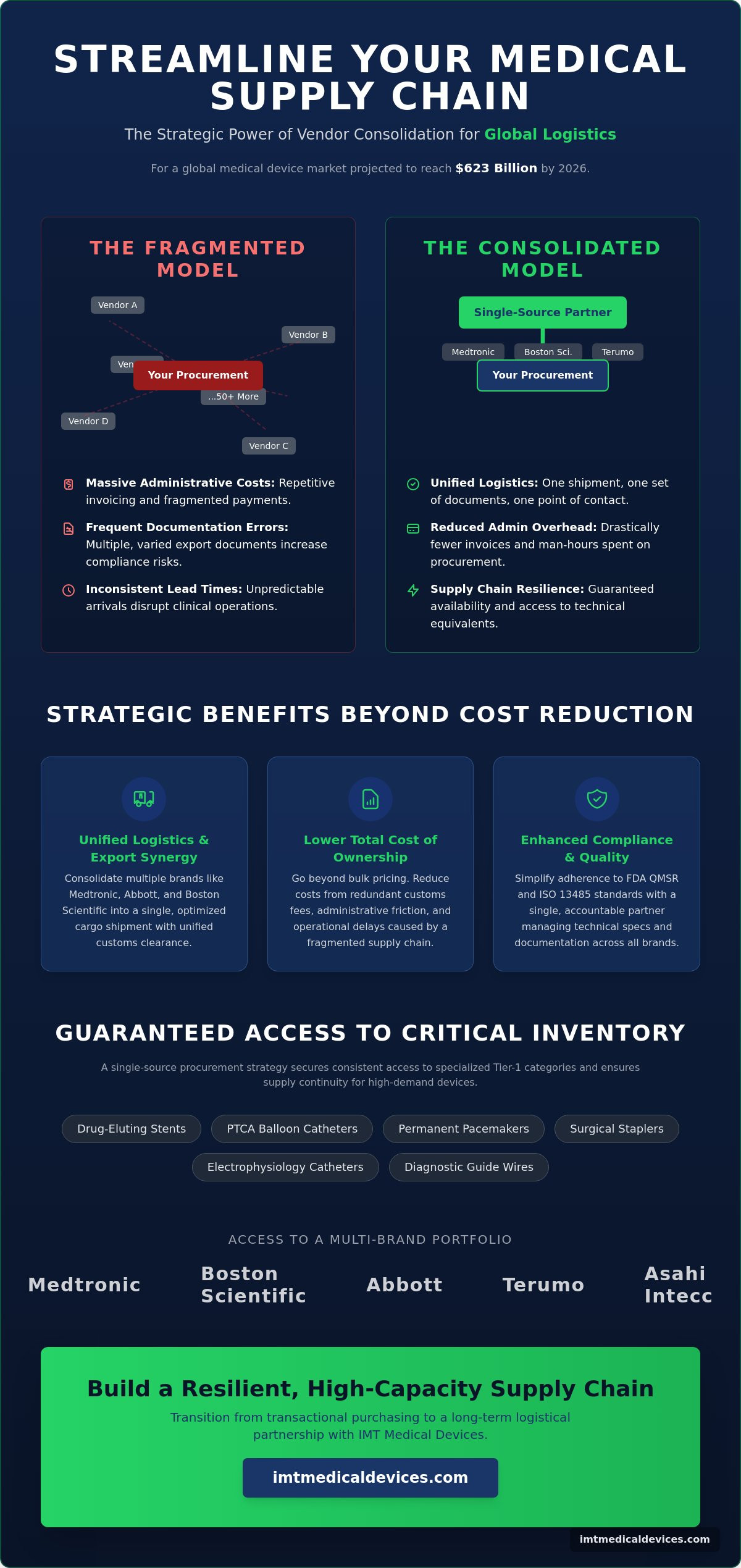
What if your current procurement strategy is the primary bottleneck in your international supply chain? Managing more than 50 separate vendors creates massive administrative costs and leads to frequent errors in export documentation. With the global medical device market reaching $623 billion in 2026, the complexity of international logistics requires a more efficient approach. Consolidating medical device vendors isn't just about bulk pricing; it's a critical logistical defense against supply chain fragmentation. You've likely seen how inconsistent lead times for critical hardware like Drug-Eluting Stents or PTCA Balloon Catheters disrupt clinical operations and inflate your total cost of ownership.
It's clear that the 2026 shift toward the FDA's Quality Management System Regulation (QMSR) and ISO 13485:2016 standards demands higher precision from your distribution partners. This guide explains how to streamline your medical supply chain to reduce logistical overhead and secure consistent access to premium manufacturers like Medtronic, Terumo, and Boston Scientific. We'll examine how to achieve unified logistics and documentation for international exports while maintaining guaranteed availability of Tier-1 inventory, including Permanent Pacemakers and Surgical Staplers. Discover the strategic framework for a more reliable, high-capacity procurement model that prioritizes product availability and technical accuracy.
Key Takeaways
- Transition from transactional purchasing to long-term logistical partnerships to eliminate administrative friction and reduce total cost of ownership.
- Streamlined international export documentation and unified logistics for critical inventory, including Drug-Eluting Stents and Permanent Pacemakers.
- Criteria for evaluating wholesalers based on technical expertise and multi-brand availability from manufacturers like Medtronic, Boston Scientific, and Terumo.
- Strategic framework for consolidating medical device vendors using phased implementation to ensure supply continuity and safety stock management.
- Single-source procurement strategies to secure consistent access to specialized categories such as Surgical Staplers and Electrophysiology Catheters.
What is Consolidating Medical Device Vendors?
Consolidating medical device vendors is the strategic reduction of active suppliers to improve procurement efficiency and supply chain reliability. It represents a fundamental shift from transactional purchasing to long-term logistical partnerships. Instead of managing dozens of individual manufacturer accounts, procurement professionals move toward high-capacity distributors capable of aggregating premium inventory. This approach is critical for high-stakes categories like interventional cardiology and cardiac rhythm management.
The 2026 global medical device market, valued at approximately $623 billion, demands a leaner vendor list. Regulatory harmonization, specifically the FDA’s adoption of ISO 13485:2016 through the Quality Management System Regulation (QMSR), requires more rigorous oversight of the supply chain. Managing 50 or more vendors increases the risk of documentation errors and compliance gaps. By consolidating, organizations ensure that technical specifications for items like Drug-Eluting Stents or Permanent Pacemakers remain consistent across all shipments. This strategy applies across cardiology, surgery, and diagnostic categories to ensure hardware availability meets clinical demand without administrative friction.
The Core Objectives of Consolidation
The primary goal is the elimination of administrative noise. Managing multiple accounts involves repetitive invoicing, varied export documentation, and fragmented shipping schedules. Consolidation reduces these man-hours significantly. It also provides volume-based leverage. When a procurement team sources Medtronic, Boston Scientific, and Terumo products through a single entity, they gain better visibility into stock levels. This centralization standardizes quality control across diverse product lines, from PTCA Balloon Catheters to Surgical Staplers, ensuring every component meets the required regulatory benchmarks.
Consolidation vs. Sole Sourcing
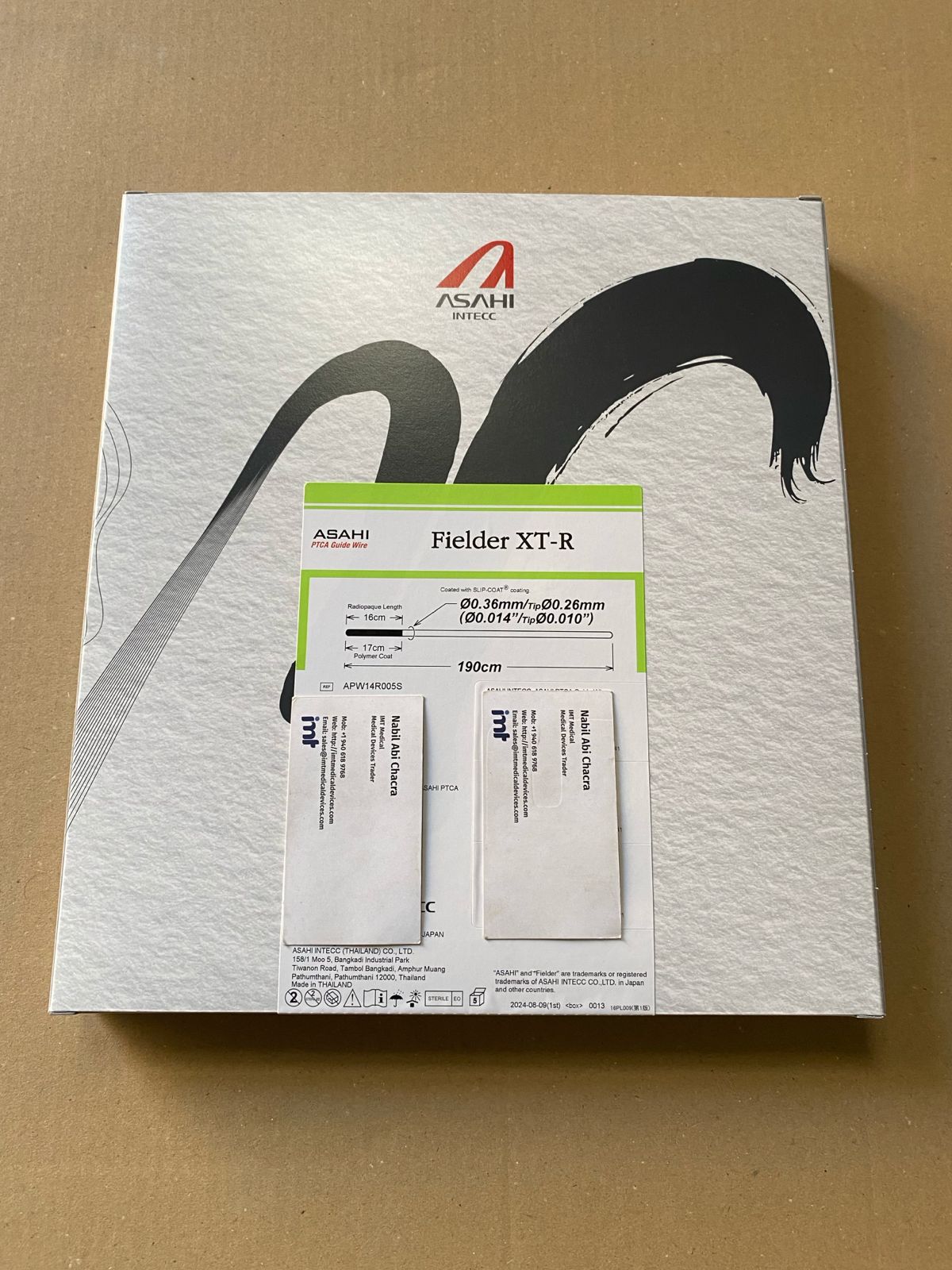
Consolidation is distinct from sole sourcing. While sole sourcing limits an organization to a single manufacturer's catalog, consolidating medical device vendors utilizes a global wholesaler as a strategic aggregator. This creates a functional form of vertical integration within the procurement process. It allows access to multiple Tier-1 brands like Asahi Intec and Abbott without the logistical burden of managing separate contracts. This model balances portfolio breadth with supply chain resilience. It ensures that if one manufacturer faces a production delay, the aggregator can provide technical equivalents within the same logistics framework. This maintains the availability of critical hardware like Electrophysiology Catheters and Diagnostic Guide Wires without disrupting clinical workflows.
Strategic Benefits: Beyond Simple Cost Reduction
Consolidating medical device vendors delivers operational advantages that extend far beyond simple volume discounts. In the high-stakes sectors of interventional cardiology and cardiac rhythm management, logistical precision is the primary driver of value. Procurement teams often struggle with fragmented shipments from dozens of manufacturers. This leads to mismatched arrival times and redundant customs fees. By adopting a framework for strategic sourcing for medical equipment, organizations centralize their supply chain under a single high-capacity partner. This shift ensures technical specifications for items like PTCA Balloon Catheters or ICDs remain consistent across the entire inventory lifecycle.
Logistical Efficiency and Export Synergy
Unified cargo handling is a critical component of 2026 procurement. Instead of managing separate export documentation for Medtronic, Abbott, and Boston Scientific, consolidation allows for unified customs clearance. This approach minimizes the risk of documentation errors that frequently cause delays at international borders. Bulk container optimization significantly lowers freight costs. Multiple product categories are shipped in a single, secure environment. Centralized tracking provides real-time visibility for sensitive items, including drug-eluting stents and Electrophysiology Catheters. Key logistical advantages include:
- Unified customs clearance for multi-brand shipments including Medtronic and Abbott.
- Lowered freight costs through bulk container optimization and reduced volumetric waste.
- Centralized tracking for high-value cardiology implants to ensure chain-of-custody integrity.
- Simplified regulatory compliance for cross-border medical device trade through standardized documentation.
Administrative and Financial Optimization
Administrative friction is a hidden cost in medical procurement. Processing 50 separate invoices for Diagnostic Guide Wires or Surgical Staplers creates massive overhead for finance departments. Consolidation simplifies this through single-invoice processing. It's an efficient way to achieve better payment terms based on the total account volume rather than fragmented spend. Total Cost of Ownership in vendor management encompasses the cumulative expense of procurement man-hours, logistical overhead, customs duties, and the financial impact of stockouts or documentation errors. Don't underestimate the impact of reducing these touchpoints on your bottom line. Organizations looking to optimize their reach can review our global distribution capabilities to see how multi-brand aggregation improves financial performance. Consolidating medical device vendors transforms the supply chain into a competitive asset by providing visibility into inventory levels for critical cardiology implants.
Evaluating Wholesalers for Multi-Brand Consolidation
Selecting a distribution partner requires a rigorous audit of manufacturer access and technical scope. Consolidating medical device vendors is only effective if the wholesaler maintains direct or high-tier access to premium brands like Medtronic, Boston Scientific, and Terumo. A partner must demonstrate deep technical expertise in specialized categories, particularly Cardiac Rhythm Management (CRM) and Interventional Cardiology. Global reach is a non-negotiable metric; verify the vendor’s capability to manage exports to over 50 countries. This logistical capacity signals financial stability and the ability to offer volume-based pricing tiers that reflect the scale of the partnership.
The Importance of Portfolio Breadth
A balanced procurement strategy requires access to both high-value implants and high-volume disposables. Evaluate the wholesaler's inventory for permanent pacemakers and ICDs alongside essential consumables. A comprehensive portfolio includes secondary but vital brands like Asahi Intec and Nipro. This breadth ensures that technical requirements for specific clinical interventions are met without sourcing from multiple entities. Inventory categories to verify include:
- Interventional Cardiology: PTCA Balloon Catheters and Drug-Eluting Stents.
- Peripheral Intervention: Peripheral Stents and Diagnostic Guide Wires.
- Surgical Hardware: Surgical Staplers and specialized Electrophysiology Catheters.
Vetting Logistical Competence
High-precision medical hardware requires specialized handling. The wholesaler must demonstrate mastery in the distribution of guidewire and catheter technologies. This includes an audit of cold chain management and sterile packaging integrity. Documentation accuracy remains a critical KPI for international medical exporters. Inaccurate export codes or incorrect manufacturer specifications lead to border delays and increased logistical overhead. Procurement professionals should prioritize partners who offer a digital-first approach to inventory feeds, allowing for rapid information retrieval and precise technical identification. This level of logistical competence is what makes consolidating medical device vendors a viable long-term strategy. Reliable partners provide the bridge between major manufacturers and international markets through industrial competence and precise data transmission.
Risk Mitigation During the Consolidation Process
Transitioning to a streamlined procurement model requires rigorous risk management to prevent clinical downtime. Consolidating medical device vendors is most effective when executed through a phased implementation strategy. Migrating specific clinical categories, such as Interventional Cardiology or Cardiac Rhythm Management, in isolated cycles reduces the operational burden on procurement teams. This methodical approach allows for the identification of potential logistical bottlenecks before they impact the entire supply chain. Continuity of care depends on the seamless availability of hardware, making a "big bang" transition unsuitable for high-stakes medical environments.
Maintaining safety stock levels is a critical requirement during the transition period. Organizations should secure a 30 to 60 day buffer of high-turnover items to account for any unforeseen onboarding delays. This safety net is vital for specialized hardware like ptca balloon catheters and Diagnostic Guide Wires. Simultaneously, the consolidated vendor's technical support team must undergo rigorous onboarding. Procurement professionals need direct access to specialists who understand the technical specifications of Medtronic, Boston Scientific, and Terumo portfolios to ensure order accuracy from day one.
Avoiding Supply Chain Disruptions
Supply chain resilience is built on data-driven forecasting. By aligning vendor stock levels with historical clinical demand, procurement teams prevent the stockouts that often occur during vendor migration. Establishing dual-sourcing for high-risk, life-saving devices like ICDs or Permanent Pacemakers provides a necessary safety net. It's also essential to standardize technical codes across the organization. Mismatched manufacturer codes frequently lead to order errors; centralizing these identifiers within a single distributor’s digital inventory feed ensures that the correct hardware arrives at the correct facility every time.
Quality Assurance and Regulatory Alignment
Centralized procurement must never compromise on product authenticity. High-capacity distributors mitigate this risk through manufacturer-direct sourcing, which eliminates the possibility of counterfeit or gray-market items entering the inventory. Every consolidated item, from Surgical Staplers to Electrophysiology Catheters, must meet both national and international regulatory standards, including the 2026 FDA QMSR requirements. Centralized documentation reduces the risk of regulatory delays by providing a single, verifiable repository for all technical and export certifications. Organizations ready to stabilize their supply chain can partner with IMT Medical Devices to access a secure, manufacturer-centric distribution network. This level of oversight ensures that consolidating medical device vendors remains a strategy for growth rather than a source of operational risk.
IMT Medical Devices: Your Single-Source Global Partner
IMT Medical Devices provides the high-capacity infrastructure required for consolidating medical device vendors in a complex regulatory environment. We maintain an exhaustive inventory of Tier-1 brands, including Medtronic, Abbott, and Terumo. Our focus is specialized hardware for interventional cardiology and surgical stapling. This pragmatic, B2B-first approach ensures that international procurement teams receive authentic technology with industrial-grade precision. Our global export infrastructure currently supports healthcare providers and distributors in over 50 nations. It's a logistical model built for scale and technical accuracy.
Integrated Product Solutions
Maximizing supply chain efficiency requires the aggregation of both high-turnover consumables and complex implants. IMT allows for the consolidation of Drug-Eluting Stents, ICDs, and Diagnostic Guide Wires into single, unified shipments. This reduces the administrative noise associated with managing separate manufacturer accounts. We leverage strategic global office locations to ensure rapid response times. Our portfolio prioritization relies on manufacturer reputation and proven clinical performance. We provide direct access to specific hardware categories including:
- Medtronic: Azure Pacemakers, Resolute Onyx DES, and PermaSpec leads.
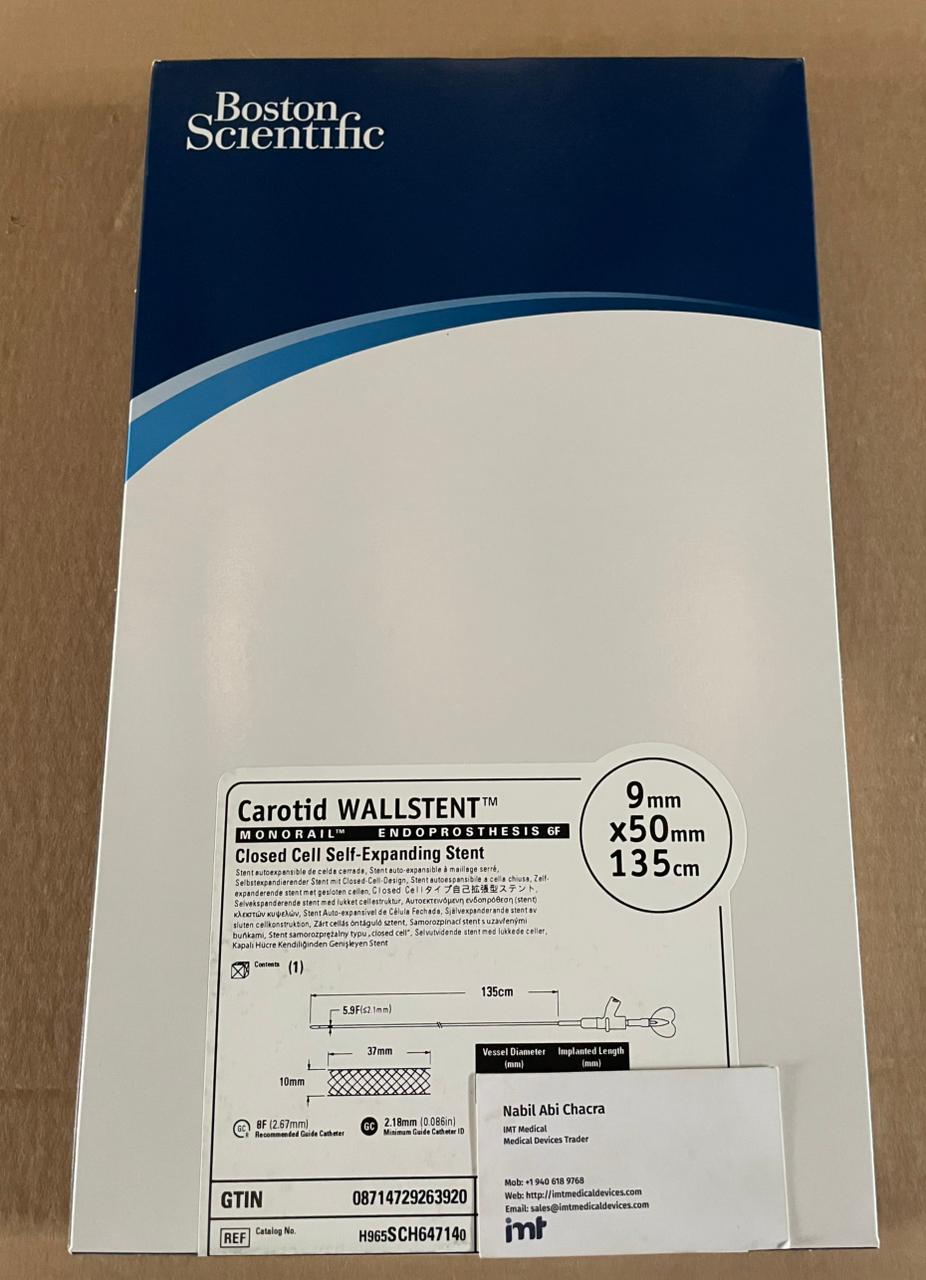
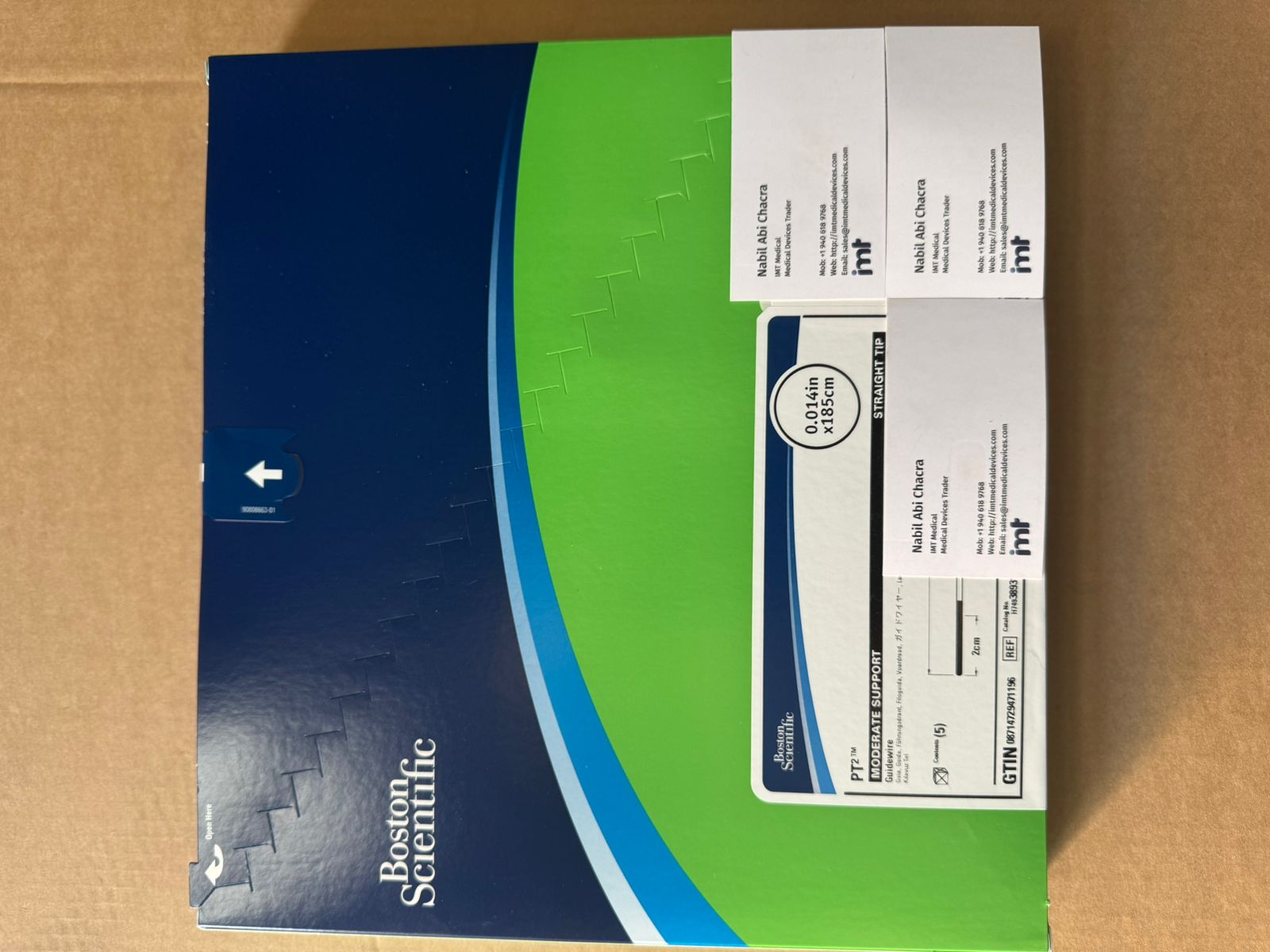
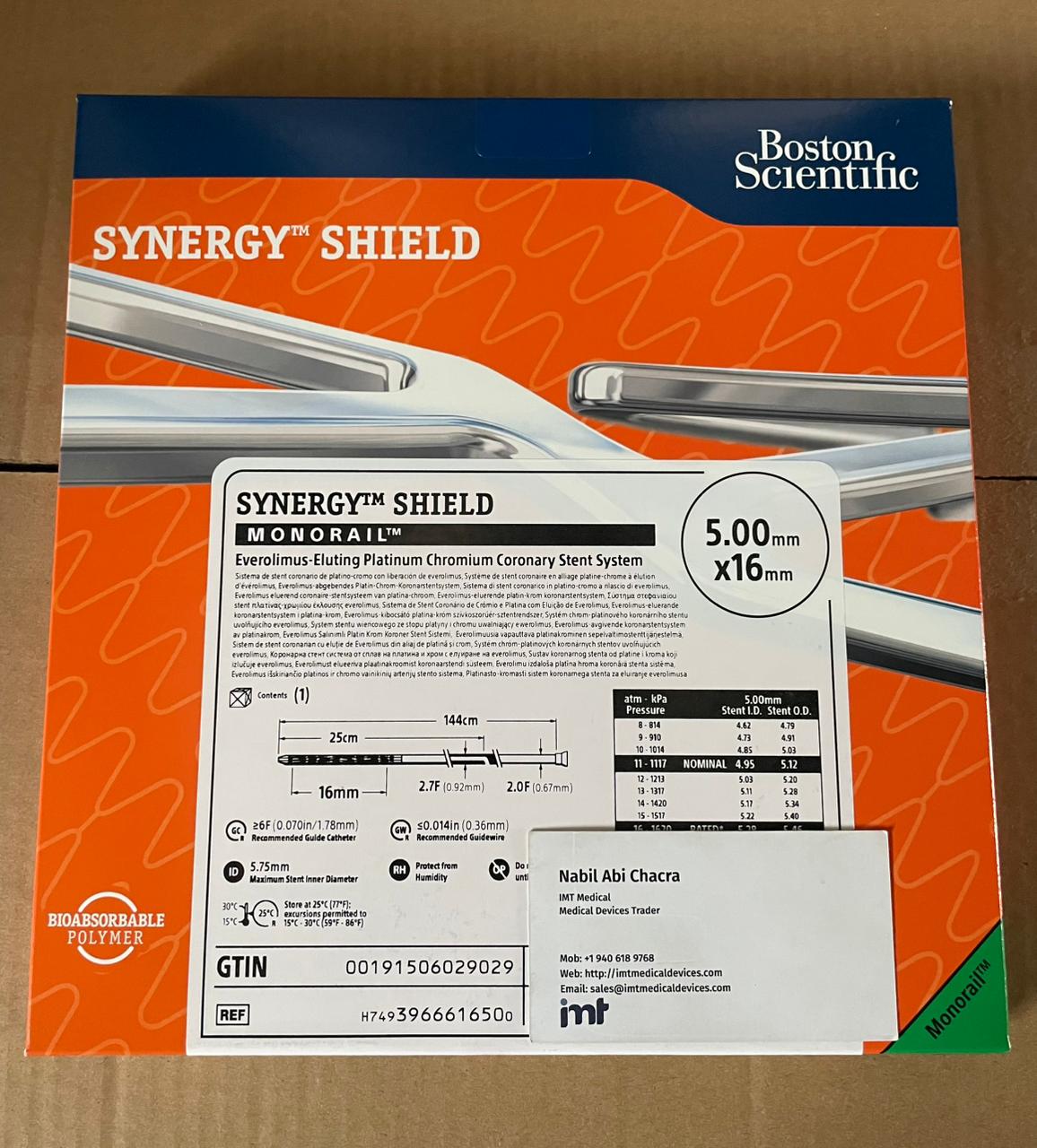
- Boston Scientific: Promus Elite DES, Dynagen ICDs, and Emerge PTCA Balloons.
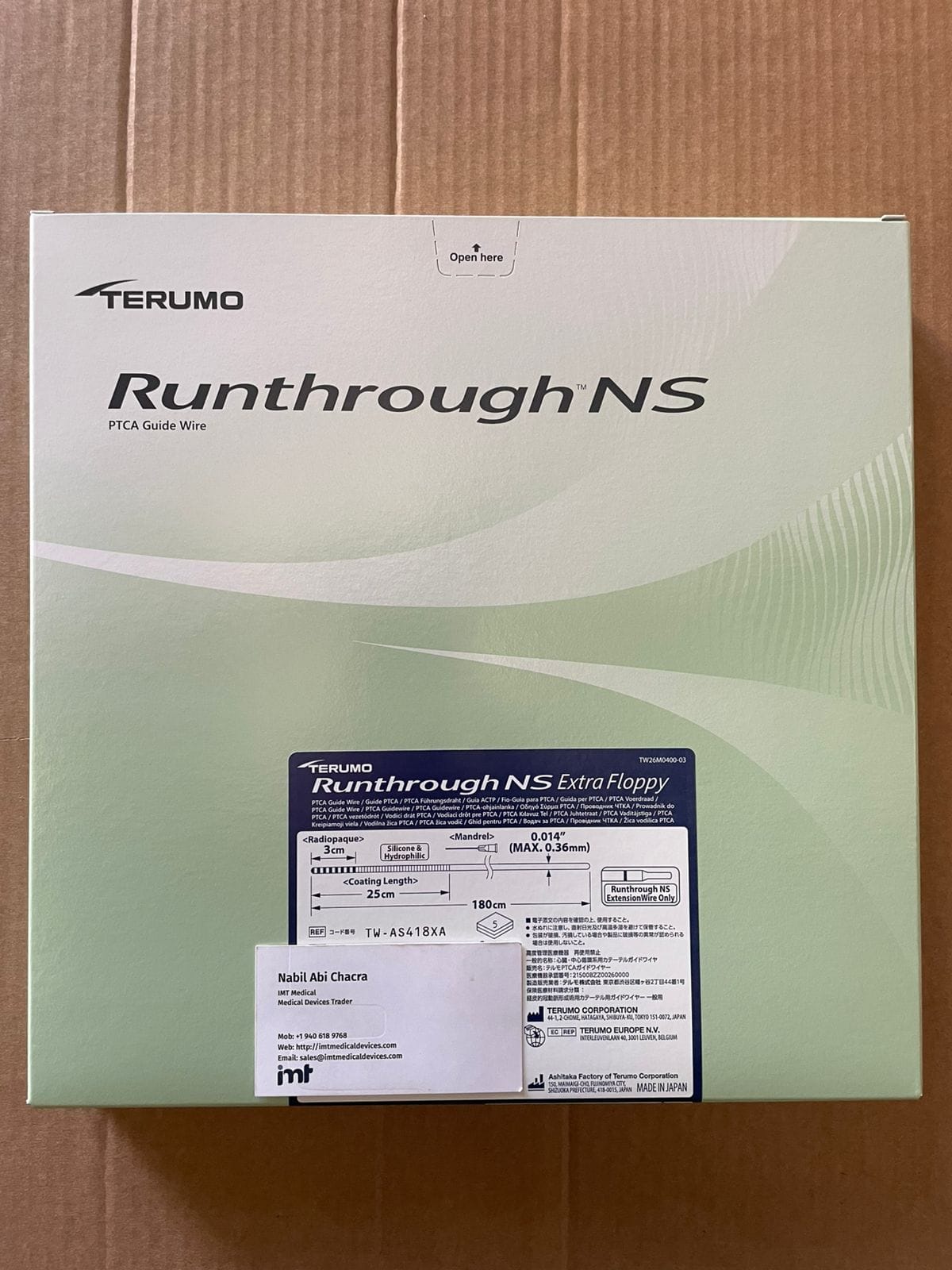
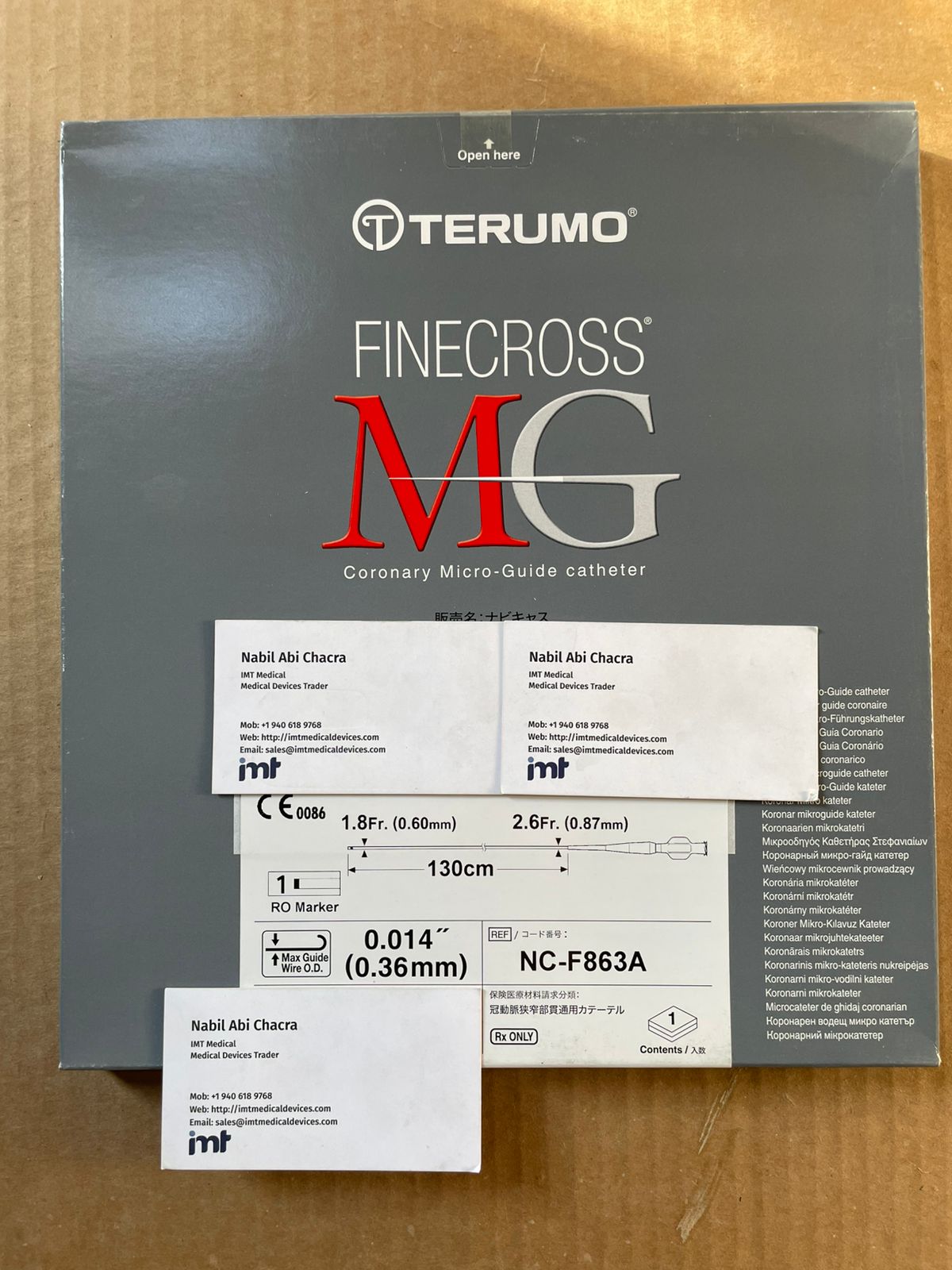
- Terumo: Radifocus Guidewires, Glidewire Advantage, and Finecross MG.
- Abbott: Gallant ICDs, XIENCE Skypoint DES, and Trek PTCA Catheters.
- Asahi Intec: Specialized guidewires and microcatheters.
The IMT Logistics Advantage
Logistical reliability is the core of our distribution model. We provide expert management of international customs and compliance documentation. This includes strict alignment with the 2026 FDA Quality Management System Regulation (QMSR). Our wholesale solutions are scalable, serving large hospital networks, specialized clinics, and regional distributors. Centralized documentation reduces the risk of regulatory delays and ensures consistent delivery of critical items like Permanent Pacemakers and Peripheral Stents. IMT serves as a vital, efficient bridge between major manufacturers and international markets. We prioritize technical accuracy and product availability, signaling our role as a serious player in the global medical supply chain. Consolidating medical device vendors through our unified platform provides the reach and scale necessary for modern medical procurement. Don't let fragmented logistics compromise your clinical operations; utilize our warehouse-to-clinic delivery model for all interventional cardiology and surgical hardware needs.
Optimizing Global Supply Chain Resilience for 2026
The 2026 procurement landscape requires a move away from fragmented supply chains toward high-capacity logistical hubs. Consolidating medical device vendors reduces the administrative burden of managing 50 or more separate manufacturer accounts. It also ensures that clinical facilities maintain consistent access to high-stakes technology like Drug-Eluting Stents and Permanent Pacemakers. By centralizing procurement through a single distributor, organizations achieve unified export documentation and lower their total cost of ownership. Success in this transition depends on partnering with a wholesaler that possesses a specialized focus on interventional cardiology and surgical hardware.
IMT Medical Devices provides this infrastructure, offering global distribution capabilities to more than 50 countries. As an authorized partner for Medtronic, Terumo, and Boston Scientific, we provide industrial-grade reliability and specialized logistics for sensitive cardiology implants. Streamline your medical procurement with IMT Medical Devices to stabilize your inventory and simplify your international operations. It's time to transform your supply chain into a strategic asset that supports both clinical excellence and logistical efficiency.
Frequently Asked Questions
What are the primary risks of consolidating medical device vendors?
Primary risks include supply chain fragility if the partner lacks technical depth or financial stability. Mitigation requires establishing dual-sourcing for life-saving hardware like ICDs and Permanent Pacemakers. Logistics errors also pose a risk if the wholesaler isn't experienced in managing complex export documentation for multiple Tier-1 brands simultaneously.
How much can a hospital save by consolidating its supplier list?
Savings are primarily realized through a lower Total Cost of Ownership (TCO). Procurement teams reduce administrative man-hours spent processing invoices and tracking fragmented shipments from dozens of vendors. Freight optimization and unified customs clearance also lower the cumulative expense of international logistics without requiring specific volume discounts.
Does vendor consolidation affect the clinical choice of specific brands?
Consolidation doesn't limit clinical choice when utilizing a high-capacity wholesaler with multi-brand access. Procurement remains flexible by sourcing Medtronic, Boston Scientific, and Terumo products through a single entity. This model ensures that physicians have access to their preferred technical specifications for Drug-Eluting Stents and PTCA Balloon Catheters.
What criteria are most important when selecting a consolidated wholesaler?
The most critical criteria include direct manufacturer partnerships and a proven export infrastructure serving 50 or more nations. Assess the vendor’s technical expertise in specialized categories like CRM and Interventional Cardiology. Financial stability and the ability to maintain safety stock for high-stakes items like Diagnostic Guide Wires are also essential.
Can vendor consolidation improve lead times for international exports?
Yes, consolidating medical device vendors improves lead times by unifying the documentation process. Single-invoice processing and consolidated cargo handling eliminate the delays often caused by mismatched arrival times or documentation errors at customs. This centralized approach ensures that critical inventory reaches its destination within a predictable timeframe.
How do I manage the transition to a single-source distributor without stockouts?
Manage the transition through a phased implementation strategy, moving clinical categories one by one. Secure a 30 to 60 day safety stock buffer for high-turnover items like Surgical Staplers and guidewires during the migration. This overlap ensures clinical continuity while the new consolidated logistics framework is fully established.
Is vendor consolidation suitable for specialized fields like interventional cardiology?
Consolidating medical device vendors is highly effective for interventional cardiology due to the high volume of specialized hardware required. Centralized sourcing ensures the consistent availability of Electrophysiology Catheters and peripheral stents. It simplifies the procurement of complex hardware by aggregating technical codes from multiple premium manufacturers into a single inventory feed.
What role does technology play in managing a consolidated vendor relationship?
Technology enables rapid information retrieval and precise inventory tracking through digital data feeds. Standardizing technical codes across the procurement platform prevents order errors during the vendor migration process. Automated tracking systems provide real-time visibility into stock levels for critical implants, ensuring that supply always aligns with clinical demand.