
Wholesale ICD and CRT-D Device Sourcing: A Global Procurement Guide for 2026
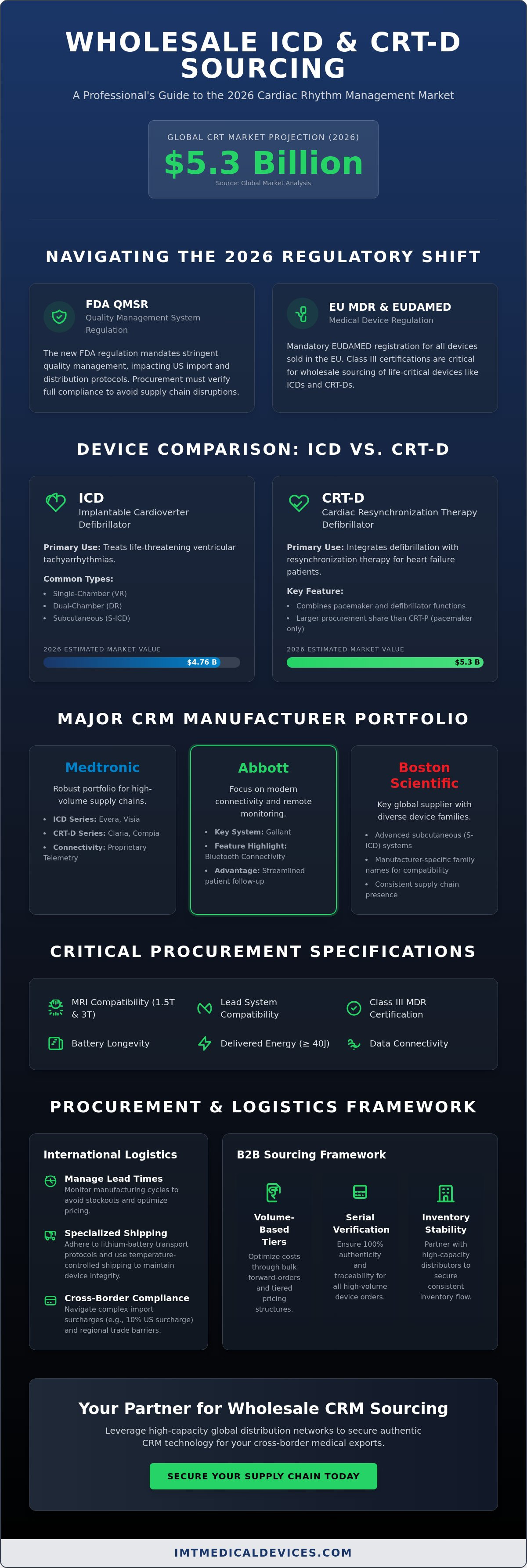
With the global CRT market reaching 5.3 billion USD in 2026, the margin for procurement error has vanished. Global supply chains currently face the simultaneous pressure of mandatory EUDAMED registration and the new FDA Quality Management System Regulation. Procurement officers recognize that managing lead time uncertainty while tracking these shifting compliance dates is a heavy operational burden. Efficient wholesale ICD and CRT-D device sourcing requires more than a vendor list. It demands precise technical alignment with manufacturers like Medtronic, Abbott, and Boston Scientific.
This guide provides a professional framework for securing high-capacity Cardiac Rhythm Management inventory. It outlines strategies to optimize procurement costs through volume-based tiers and ensure 100% regulatory compliance for international shipping. We'll analyze manufacturer specifications, logistical efficiency, and the impact of the 2026 US import surcharge on global distribution. This overview covers Class III MDR certification requirements and the technical data needed for bulk procurement of MRI-compatible devices.
Key Takeaways
- Identify critical 2026 regulatory shifts affecting procurement, including FDA QMSR and EU MDR compliance deadlines.
- Compare technical specifications across Medtronic, Abbott, and Boston Scientific to align inventory with clinical hardware requirements.
- Implement a professional framework for wholesale ICD and CRT-D device sourcing using volume-based pricing tiers and serial number verification.
- Master specialized logistical protocols for lithium-battery transport and temperature-controlled shipping to maintain device integrity.
- Leverage high-capacity global distribution networks to secure authentic CRM technology for cross-border medical exports.
The Global Landscape of Wholesale ICD and CRT-D Sourcing
Global CRM procurement in 2026 operates under strict regulatory frameworks. Efficient wholesale ICD and CRT-D device sourcing involves managing Class III life-critical hardware across international borders. Implantable Cardioverter Defibrillators (ICDs) treat ventricular tachyarrhythmias, while Cardiac Resynchronization Therapy Defibrillators (CRT-Ds) integrate resynchronization therapy for heart failure patients. For a technical perspective on these systems, see this Implantable Cardioverter-Defibrillator (ICD) Overview. High-volume procurement differs from clinical trial sourcing by focusing on established, MDR-certified platforms ready for immediate hospital deployment. Wholesalers prioritize inventory stability over experimental data collection.
The 2026 market reflects an estimated USD 4.76 billion valuation for ICDs and USD 5.3 billion for CRT systems. Demand drivers include aging populations in North America and rapid healthcare infrastructure expansion in the Asia-Pacific region. International wholesalers act as the primary logistical bridge. They ensure that inventory from Medtronic, Abbott, and Boston Scientific reaches emerging markets despite complex 10% import surcharges or regional trade barriers. This role is vital for maintaining the supply chain between major manufacturing hubs and regional healthcare providers.
Inventory Categories: ICD vs. CRT-D Specifications
Wholesale inventory is categorized by chamber configuration and therapeutic capability. ICD sourcing requirements typically split between single-chamber (VR) and dual-chamber (DR) units. CRT-D devices represent a larger share of resynchronization procurement compared to CRT-P (pacemaker only) units due to the added defibrillation safety net. Technical identifiers are manufacturer-specific. Procurement teams must track codes such as Medtronic's VR/DR designations or Boston Scientific's specific family names to ensure hardware compatibility with existing lead systems. Accurate nomenclature prevents costly inventory errors in high-volume orders.
Market Demand and Supply Chain Stability in 2026
Supply chain stability depends on manufacturer output and regulatory alignment. Medtronic and Abbott currently lead the 2026 supply chain with robust Class III portfolios. However, manufacturing lead times for advanced subcutaneous (S-ICD) and leadless systems can impact wholesale pricing tiers. Shorter lead times often command premium pricing, while bulk forward-orders allow for significant cost optimization. Projections show steady CRM device adoption in international healthcare systems, particularly as MRI-compatible technology becomes the baseline standard for all new implantations. Reliable wholesale ICD and CRT-D device sourcing requires constant monitoring of these manufacturing cycles to avoid stockouts during peak demand periods.
Technical Comparison of Major CRM Manufacturers
Professional wholesale ICD and CRT-D device sourcing in 2026 centers on manufacturer-specific performance metrics. Procurement officers prioritize battery longevity and lead technology to minimize replacement frequency. All devices must adhere to FDA technical standards for CRM devices (ISO 14708-6) to ensure safety and authenticity. Sourcing decisions now hinge on MRI compatibility. 1.5T and 3T ratings are standard requirements for modern clinical environments. High-volume orders must verify these specifications to meet hospital tender requirements. Effective strategies for wholesale ICD and CRT-D device sourcing involve comparing these manufacturer footprints against regional clinical standards.
Connectivity features define the current logistical landscape. Abbott Gallant systems utilize Bluetooth for remote monitoring, allowing for streamlined patient follow-up. Medtronic maintains a focus on proprietary telemetry for data security. These technical distinctions dictate the necessary programming hardware for end-users. Procurement teams should evaluate device footprint and delivered energy (Joules) to match specific patient demographics. Most 2026 models offer 40J or higher for effective defibrillation. Digital integration has moved from a premium feature to a baseline procurement necessity.
Medtronic Cardiac Rhythm Management Portfolio
Medtronic remains a primary target for bulk procurement. The Evera and Visia ICD series provide high-capacity sensing algorithms and lead integrity. For heart failure management, Medtronic CRT-D solutions like the Claria and Compia series offer advanced resynchronization features. These units are essential for high-volume hospital supply chains. Reliable access to Medtronic CRM products ensures inventory stability for critical care facilities. Medtronic's focus on leadless systems also represents the fastest-growing segment for 2026 sourcing, addressing the demand for reduced lead-related complications.
Abbott and Boston Scientific Device Sourcing
Abbott Gallant and Entrant series feature smartphone-integrated monitoring. These technical identifiers are vital for B2B documentation and serial number tracking. Boston Scientific RESONATE and PERCEPTA platforms emphasize battery duration. Note that the March 2026 Boston Scientific urgent correction for battery issues in specific families has redirected demand toward current MDR-certified stock. Procurement specialists must distinguish between these corrected units and older inventory to maintain clinical safety. Footprint reduction remains a key selling point for these manufacturers.
- Abbott Gallant: Bluetooth connectivity, 1.5T/3T MRI compatibility, smartphone remote monitoring.
- Boston Scientific RESONATE: EnduraLife battery technology, 41J delivered energy, 3T MRI conditional.
- Medtronic Evera: SmartShock 2.0 algorithms, PhysioCurve design, 1.5T/3T MRI compatibility.
B2B Procurement Framework: Tiers, Pricing, and Authenticity
Successful wholesale ICD and CRT-D device sourcing requires a rigorous commercial framework. Wholesale pricing in 2026 isn't a fixed metric; it relies on structured volume-based tiers. High-volume procurement professionals use these tiers to mitigate the impact of the 10% global import surcharge effective as of February 2026. Navigating these costs requires precise tariff classification for international trade. For a specific example of classification standards, see this U.S. Customs tariff ruling on ICD equipment. Establishing redundancy through multi-brand contracts with Medtronic, Abbott, and Boston Scientific ensures inventory remains stable even during manufacturer-specific supply disruptions.
Managing expiration dates is a critical logistical requirement for sterile-packed cardiac implants. Most ICD and CRT-D units have a defined shelf life that procurement teams must track via serial number databases. Inventory rotation must prioritize devices with shorter remaining sterile life to prevent capital loss. This level of oversight is standard for professional wholesale ICD and CRT-D device sourcing operations. It's essential to verify that all hardware aligns with current ISO 13485:2016 quality management standards before accepting bulk shipments.
Authenticity and Regulatory Compliance
Verification protocols must confirm CE Mark and FDA approval before any international distribution. Every unit requires original manufacturer packaging with intact sterile seals. Tamper-evident packaging is the primary indicator of product integrity. Procurement teams utilize Unique Device Identification (UDI) to track hardware from the production line to the final destination. This tracking prevents the entry of counterfeit or recalled units into the supply chain. Mandatory EUDAMED registration, effective May 28, 2026, makes this digital traceability a legal requirement for all economic operators.
Optimizing Procurement Costs and Lead Times
Bulk orders stabilize pricing against currency fluctuations and shipping volatility. Consolidating orders across multiple manufacturers like Abbott and Medtronic allows distributors to leverage higher discount brackets. Managing backorder risks involves diversifying the sourcing pool. If one manufacturer faces a Class I recall, such as the 2026 software correction for specific battery issues, having an alternative supply of MDR-certified devices is vital. For procurement strategies involving related CRM hardware, see our guide on permanent pacemakers for technical and commercial insights. Procurement efficiency depends on this balance of volume, compliance, and multi-brand availability.
International Logistics and Export Compliance for CRM Devices
Global distribution of CRM hardware involves specialized handling of lithium-battery powered medical devices. Professional wholesale ICD and CRT-D device sourcing requires strict adherence to IATA Dangerous Goods Regulations (DGR). These units are classified under UN3481 for air transport. Logistics providers must ensure compliance with Packing Instruction 970 to prevent thermal runaway or accidental activation. Sensitive electronic shipping requires temperature-controlled environments, typically maintained between 15°C and 25°C. This prevents electrolyte leakage or battery capacity loss during long-haul transit. Maintaining controlled-ambient status is a non-negotiable quality assurance metric for high-value cardiac inventory.
Risk mitigation for international shipping centers on logistical integrity. Hermetically sealed devices are vulnerable to extreme pressure changes and physical impact. High-capacity exporters use multi-layered, shock-absorbent packaging to protect the sterile seal. Real-time GPS tracking and data loggers provide visibility into humidity and orientation throughout the journey. This oversight prevents the acceptance of compromised inventory at the destination port. For broader insights into supply chain optimization, read about medical device distribution for international markets. Logistics excellence ensures that manufacturer specifications remain intact from the warehouse to the clinical setting.
Regulatory Documentation for Global Export
Cross-border medical exports demand precise documentation to avoid customs delays. Certificates of Free Sale (CFS) and Certificates of Origin are mandatory for most jurisdictions. In 2026, mandatory registration of economic operators in EUDAMED adds a layer of digital compliance for all EU-bound shipments. Customs clearance for high-value technology requires accurate HS Code classification to manage the 10% global import surcharge. Incomplete paperwork results in port storage fees and potential sterile-life expiration. Procurement teams must verify that all export documents match the Unique Device Identification (UDI) data for every unit in the consignment. Accurate documentation is the primary trust signal in wholesale ICD and CRT-D device sourcing.
Logistical Integrity and Quality Assurance
Quality management systems (ISO 13485:2016) extend to the distribution phase. Wholesalers must provide evidence of specialized handling for Medtronic, Abbott, and Boston Scientific hardware. This includes verifying that shipping containers meet manufacturer specifications for electronic components. Secure your supply chain by partnering with a distributor capable of 100% regulatory compliance. Contact us to source authentic CRM inventory for your international distribution needs. Logistical reliability is the bridge between major manufacturers and global healthcare providers.
IMT Medical Devices: Your Partner for Wholesale CRM Sourcing
IMT Medical Devices functions as a high-capacity bridge between premium manufacturers and international markets. We manage wholesale ICD and CRT-D device sourcing for healthcare providers and regional distributors across more than 50 countries. Our inventory features MDR-certified hardware from market leaders such as Medtronic and Boston Scientific. Strategic distribution hubs in Georgia, Dubai, Turkey, and Poland ensure rapid fulfillment and logistical agility for high-value consignments. We provide professional B2B support for customs documentation, IATA-compliant logistics, and volume-based pricing structures.
High-capacity wholesale ICD and CRT-D device sourcing requires a partner with industrial competence and a focus on supply chain stability. IMT Medical Devices specializes in the movement of life-critical cardiac technology. We maintain a manufacturer-centric approach. This ensures that every unit in our warehouse meets original producer specifications and sterile-seal integrity. Our logistical framework handles the complexities of the 10% global import surcharge and mandatory EUDAMED registration effective May 2026. Partners benefit from a centralized point of access for complex CRM requirements.
Global Reach and Logistical Expertise
IMT Medical Devices maintains a proven track record in managing sensitive medical technology supply chains. We provide efficient export solutions tailored for large-scale healthcare providers and regional distributors. Our commitment focuses on providing authentic, high-quality CRM hardware. Every shipment undergoes rigorous quality assurance protocols. We track Unique Device Identification (UDI) data to ensure total transparency from the manufacturer to the end-user. Our expansive distribution network minimizes lead times for emerging markets. We prioritize product availability and technical accuracy over brand storytelling. Industrial competence is our primary trust signal in the global market.
Next Steps for Wholesale Procurement
Professional procurement begins with accurate technical data and commercial transparency. Request a manufacturer-specific price list for 2026 to align your inventory needs with current market availability. Our team provides detailed specifications for Medtronic, Abbott, and Boston Scientific portfolios. Consulting with IMT logistics experts on international shipping requirements prevents costly customs delays. Our support doesn't end at delivery; we assist with the documentation required for the FDA's QMSR and EU MDR compliance. Secure your supply chain with a reliable, high-capacity international distributor.
Contact IMT Medical Devices for bulk ICD and CRT-D sourcing.
Our portfolio for 2026 includes:
- Medtronic Products: Evera and Visia ICD series, Claria CRT-D units.
- Boston Scientific Products: RESONATE and PERCEPTA platforms.
- Abbott Products: Gallant and Entrant series technical identifiers.
- CRM Hardware: Permanent pacemakers, lead systems, and diagnostic catheters.
Securing High-Capacity CRM Inventory for Global Markets
Successful wholesale ICD and CRT-D device sourcing requires a manufacturer-centric approach and strict adherence to the 2026 regulatory landscape. Procurement professionals must balance technical specifications from Medtronic, Abbott, and Boston Scientific with the logistical demands of international transport. Maintaining 100% compliance with FDA QMSR and EU MDR standards is the baseline for inventory security. Managing these complexities ensures that critical care facilities receive authentic, high-performance hardware without stockout risks. Industrial competence in handling Class III devices remains the primary differentiator for successful global distribution.
IMT Medical Devices provides the necessary infrastructure for high-volume cardiac rhythm management procurement. We currently export to over 50 countries through strategic offices in Georgia, the UAE, Turkey, and Poland. Our status as a distributor for Medtronic, Abbott, and Boston Scientific ensures access to authentic, sterile-packed hardware from the world's most prestigious manufacturers. Request a Wholesale Quote for ICD and CRT-D Devices to stabilize your 2026 supply chain and optimize your procurement costs. We're prepared to facilitate your next high-capacity order with logistical precision and technical accuracy.
Frequently Asked Questions
What is the primary difference between sourcing an ICD and a CRT-D for wholesale?
ICD sourcing focuses on hardware for tachyarrhythmia management, while CRT-D sourcing requires inventory with integrated resynchronization therapy for heart failure. Wholesale orders for CRT-D devices involve higher unit complexity and specific lead compatibility requirements. Procurement teams must categorize these by chamber configuration, such as VR or DR, to align with specific hospital tender specifications and clinical needs.
How do manufacturers like Medtronic and Abbott differ in their 2026 CRM offerings?
Medtronic focuses on leadless technology and advanced sensing algorithms like SmartShock 2.0 in the Evera series. Abbott emphasizes digital connectivity, utilizing Bluetooth integration for remote patient monitoring in their Gallant and Entrant portfolios. These technical distinctions dictate the programming hardware and software ecosystems required by the end-user clinical facility, affecting long-term procurement planning for hospital systems.
What are the regulatory requirements for exporting ICD devices internationally?
Exporting ICD devices requires valid Certificates of Free Sale, Certificates of Origin, and compliance with FDA QMSR or EU MDR certification. As of May 28, 2026, all economic operators must be registered in the EUDAMED database for EU-bound shipments. Accurate HS Code classification is essential to manage global import surcharges and ensure efficient customs clearance at international ports of entry.
How is the authenticity of wholesale medical devices verified?
Authenticity is verified through Unique Device Identification tracking and inspection of original manufacturer packaging seals. Professional wholesale ICD and CRT-D device sourcing protocols involve cross-referencing serial numbers against manufacturer databases to confirm production dates and sterile-life status. Tamper-evident packaging and intact hermetic seals serve as primary indicators of product integrity during the inventory intake process.
What are the typical lead times for bulk orders of Boston Scientific CRT-Ds?
Lead times for Boston Scientific CRT-Ds depend on current manufacturing cycles and specific product families like RESONATE. While standard inventory is often available for immediate export, bulk orders for the latest MDR-certified models may require 4 to 8 weeks for fulfillment. High-capacity distributors maintain buffer stocks to mitigate delays caused by software updates or manufacturer medical device corrections.
Can ICD and CRT-D devices be shipped via standard air freight?
ICD and CRT-D devices require specialized air freight handling due to their lithium-ion battery components. They're shipped as Class 9 Dangerous Goods under UN3481 regulations and Packing Instruction 970. Standard air freight is only permissible when the carrier is certified for dangerous goods transport and maintains temperature-controlled environments between 15°C and 25°C to prevent battery degradation.
What impact does MRI compatibility have on CRM device procurement?
MRI compatibility is now a baseline requirement for modern wholesale ICD and CRT-D device sourcing. Hospitals prioritize 1.5T and 3T MRI-conditional devices to ensure patients can undergo diagnostic imaging safely. Procurement teams must verify the specific conditional labeling for each device and lead combination to meet the clinical standards of advanced healthcare systems and regional medical tenders.
How do volume-based pricing tiers work for international medical distributors?
Volume-based pricing tiers offer structured discounts based on the total unit count or contract value of the CRM order. Larger procurement volumes allow distributors to stabilize costs against shipping volatility and the 10% global import surcharge. These tiers are typically structured to reward consolidated multi-brand orders, allowing providers to optimize capital expenditure across Medtronic, Abbott, and Boston Scientific portfolios.